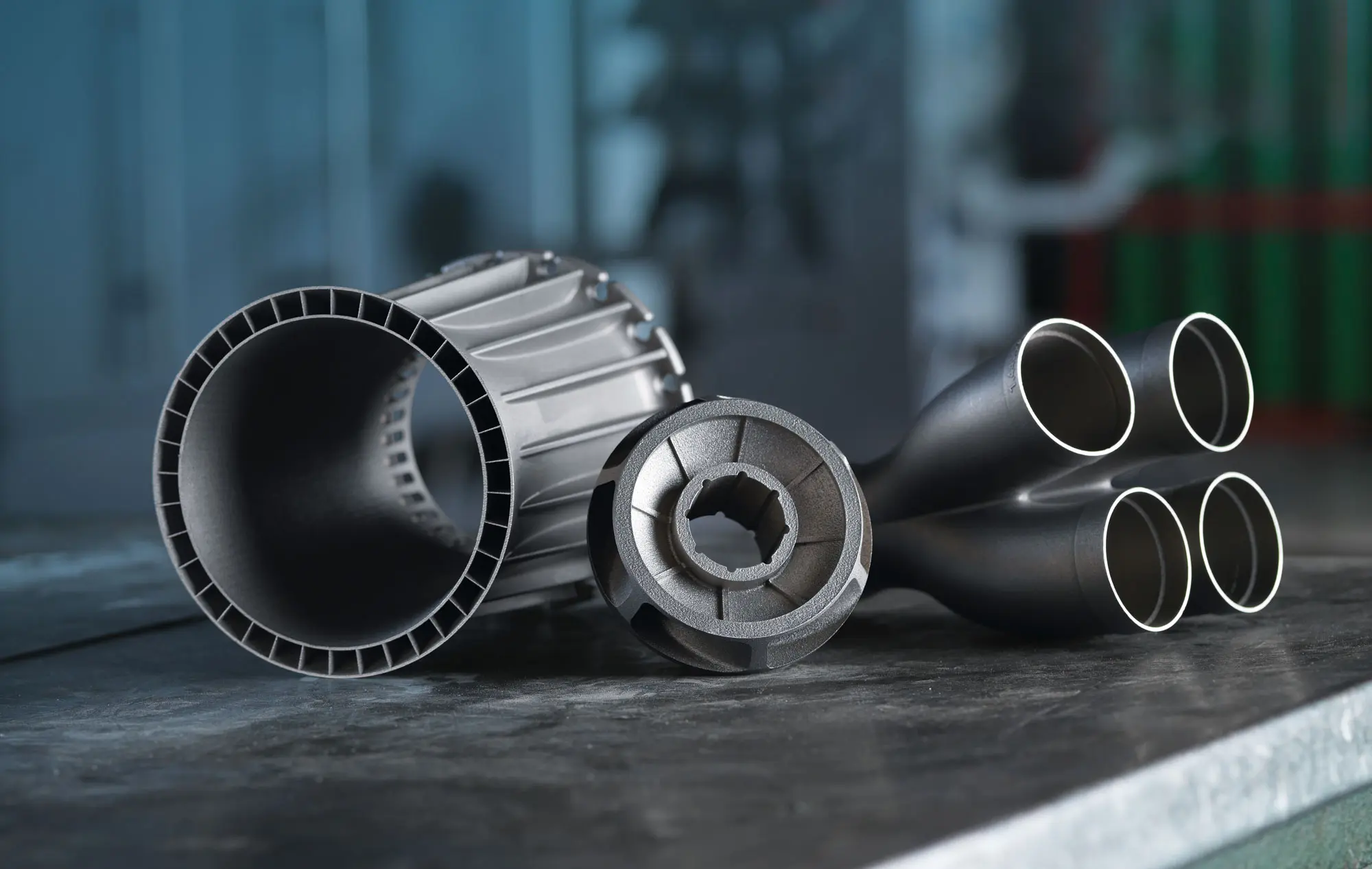
Sports Revolution: The Potential for Starting with 3D Printed Ball Joints
From sophisticated robot arms to high-performance car suspensions, ball joints play a key but often underestimated role in the complex dance of machines. These spherical connections can rotate freely in almost any direction, allowing for smooth expression under load. Traditional manufacturing methods such as casting and processing have long occupied the production of ball joints. However, the emergence of advanced 3D printing, especially metal additive manufacturing (AM), has fundamentally changed the way these key components are designed and produced. exist GreatWe utilize cutting-edge SLM (Selective Laser Melting) technology to provide spherical joints with fast prototype solutions to push the boundaries of performance and efficiency.
Beyond Simple Pivots: The Key Function of Ball Joints
The ball joint is fundamentally composed of spherical bearings within the socket, so that it can rotate on multiple axes. This simple concept is the basis for complex movements in countless applications:
- car: Connect the control arm to the steering knuckle for suspension movement and steering.
- Robotics: Provides flexibility and flexibility in robotic arms, grip and joints.
- Industrial Machinery: Enable expression in chains, conveyors and professional equipment.
- Aerospace and Defense: For flight control surfaces, landing gear mechanisms and satellite components are crucial.
- consumer goods: Found in ergonomic furniture, medical devices and even high-end camera tripods.
Demand is high: they must withstand heavy pressure, resist wear and corrosion, maintain precise tolerances, and provide smooth operation over millions of cycles. Failure is usually not an option to make reliability supreme.
Why 3D printing? Ball joint design changes the advantages of gameplay
Metal 3D printing goes beyond the limitations of traditional methods and can unlock unprecedented possibilities for ball joint development and production:
- Final design freedom and topological optimization: SLM 3D printing has freed designers from the limitations of subtraction processing or casting molds. Lubricate the complex internal cavity of the channel, self-sufficient lightweight lattice structure to reduce mass while maintaining strength, while nature-inspired bionic designs such as human joints become feasible. Topology optimization software can be used to iteratively design parts to maximize the stiffness-to-weight ratios unique to the application load path, which is impossible to use conventional methods.
- Lightweight without sacrificing power: In aerospace, automotive and robotics, reducing the weight of components is directly translated into improved fuel efficiency, agility and payload capability. 3D printing excels in creating high-strength, hollow or lattice-filled structures that accurately exudes unnecessary mass structural integrity while maintaining and even enhancing the joint’s load-bearing capacity.
- Internal functions: Complex cooling channels embedded in lubricant or stem are insignificant with AM. This can better lubricate the distribution, reduce maintenance intervals, and even actively cool in high friction or high temperature environments.
- Rapid prototype and iteration: This is Great shine. Developing the best ball joint design often requires multiple iterations. Traditional tools are expensive and slow. SLM 3D printing allows the production of functional metal prototypes in days rather than weeks or months. Engineers can conduct real-life load testing earlier in the design cycle, forming and critical functions, greatly accelerating time to market and reducing overall development risks and costs.
- Reduce part counting and assembly: 3D printing can integrate multiple traditionally processed components such as housings, fixers and seals into a complex printed section. This eliminates the assembly step, reduces potential failure points, improves overall stiffness and simplifies inventory.
- Material versatility and performance: Great advanced SLM capabilities handle a broad spectrum of high-performance metal powders: from strong and versatile titanium alloys (Ti6Al4V) essential for aerospace and medical impants, to corrosion-resistant stainless steels (316L, 17-4PH), lightweight aluminum alloys (AlSi10Mg, AlSi7Mg), and durable nickel alloys like Inconel for extreme temperature and corrosion environment. This allows for precise selection of materials to be tailored to the joint’s operational needs.
Overcoming the Challenge: Key Design and Manufacturing Considerations for 3D Printed Ball Joints
Although powerful, successful 3D printed ball joints require expert attention to details:
- Support structure: Complex overhangs, especially inside the socket, require support of the structure during printing. It is crucial to make an easy-to-removal design without damaging the functional surface. Great Process expertise minimizes residual stress and optimizes support for effective post-processing.
- Surface and tribology: The surface roughness of metal AM parts will affect the friction and wear of critical bearing interfaces. Post-processing is crucial. Such as ball/socket clearance, surface texture optimization in design, and appropriate factors GRESTLIGHT Post-processing Service (Machining, polishing, grinding, surface treatment (such as DLC coating or nitration)) is essential for smooth operation and longevity.
- Direction and pressure management: Partial orientation on the construction plate significantly affects mechanical properties, surface quality and residual stress distribution, which is especially important for the high-stress neck area of the ball stud. Greglight’s engineering team Use simulation tools to optimize orientation and laser parameters for optimal material properties.
- Tolerance and Accuracy: The precise dimensional tolerances required to achieve smooth pronunciation, especially the gap between the ball and the socket, depend heavily on expert machine calibration and process control. Greglight’s commitment to precision machining Extend to the critical mating surface defined after construction where necessary to ensure a perfect fit and function in assembly.
One-stop solution: From digital model to finished part:
At Greatlight, we specialize in simplifying our customers’ journey. Our fast prototype expertise is not limited to printing original parts:
- Consulting and design optimization: Work with our engineers early to optimize your ball joint design for AM manufacturing and performance.
- Advanced SLM Manufacturing: Leverage state-of-the-art SLM machines handled by experts for consistent high-quality metal parts.
- Comprehensive post-processing: Access a complete suite One-stop organization service: Precision CNC machining of critical surfaces, support disassembly, media blasting, heat treatment (annealing, pressure relief, aging, hips – when needed), polishing, grinding and advanced functional coatings (wear, wear, low wear, corrosion resistance, corrosion resistance) that can be customized to ball joint performance according to ball joint energy body.
- Quality Assurance and Inspection: Strict inspections (CMM, optical scanning, surface roughness measurement, material testing) ensure that each ball joint meets strict specifications.
Conclusion: Embrace the future of pronunciation
3D printed ball joints are not only replicas of similar products traditionally made; they represent leaps in functionality, performance and design possibilities. By overcoming the limitations of conventional manufacturing, additive manufacturing allows engineers to create lighter, stronger, more complex, and ultimately better-performing expression joints for the most demanding applications.
Greglight is at the forefront of this revolution. With our deep expertise in SLM Metal 3D printing, extensive material features and comprehensive expertise One-stop post-processing and completion serviceWe have a unique location to solve your rapid prototyping and production challenges such as critical components such as ball joints. We can not only make parts simply – we work with you to unlock innovative solutions, optimize designs and accelerate your product development cycle.
Explore the advantages of custom, precision, high-performance 3D printed ball joints. Work with Greatlight, one of China’s leading rapid prototyping companies, and discover how we can bring your next generation mechanism to life and come to life at the best prices. Let’s customize your solution now.
FAQ: 3D printed ball joints
-
Are 3D printed balls as strong as traditionally made spherical joints?
Absolutely. When properly designed for additive manufacturing and processed using advanced SLM technology (such as using) GreatIn combination with appropriate post-processing heat treatment, 3D printed metal ball joints can achieve mechanical properties equal to or even exceed cast or forged equivalents (tensile strength, yield strength, fatigue life). Materials such as titanium and high-strength steel perform well.
-
What surface surface can be achieved on the bearing surface? What post-processing is needed?
this "first aid" The SLM’s surface finish is usually rough and is not suitable for direct bearing contact. Critical post-processing is crucial. Greglight provides precise machining, grinding or grinding To achieve the required smoothness of the ball and socket interface. Further treatment Low friction coatings (e.g. DLC-diamond carbon) Minimizing wear and friction is strongly recommended, resulting in significant improvement in durability and performance.
-
How do you manage the support structure issues inside the ball socket?
Designing for additive manufacturing (DFAM) is key. Our engineers optimize the design and establish orientations to minimize support in hard-to-reach areas such as the sleeve interior. In the inevitable support, Greatlight adopts professional support strategies combined with skilled post-processing techniques (Precision EDM, micromechanical surgery, meticulous manual removal and polishing) Ensure that the critical functional surfaces within the socket are clean, smooth and without damage or residue after removal.
-
What are the biggest advantages of a prototype ball joint with 3D printing?
The main advantages are Speed and flexibility of iterative design:
- Quick iteration: Test multiple design versions (different wall thicknesses, internal features, gaps, materials) over a few days rather than months.
- Functional test: The prototype is a functional high-strength metal part that can be tested in real-time load early in development.
- Complex geometric shapes: Use traditional methods earlier to validate fundamentally innovative designs (such as integrated channels or grids).
- Reduce costs: Avoid the high cost and advance time of using prototypes.
-
Can Greatlight handle production volumes for prototypes and end-uses?
Yes, absolutely. Gremight excels in both rapid prototyping and low to medium volume production. Our advanced SLM equipment and effective post-processing workflows are designed to deliver high-quality parts quickly, whether you need a single functional prototype for testing or hundreds of parts or niches for pre-production runs. We effectively scale to meet your needs.
- Which materials are best for 3D printed ball joints?
The choice depends entirely on the application:
- High strength and lightweight: Titanium alloy (TI6AL4V) Ideal for aerospace, medical and motorsports.
- Corrosion resistance and general purpose: Stainless steel (316L, 17-4PH) It is widely used.
- Lightweight and good power: Aluminum alloy (ALSI10MG, ALSI7MG) Suitable for applications where weight is critical and moderate load is moderate.
- Extreme heat and corrosion: Nickel alloy (Inconel 718, 625) It is unparalleled.
Greglight offers quick customization with a wide range of metal materials – Consult our team for the best choice.