Cutting edge: How 3D printing revolutionizes Formula One automotive design
The roar of the engine, the blur of speed, the ruthless pursuit of millisecond advantage – Formula One is the pinnacle of automotive engineering. Behind the scenes, ruthless innovation drives performance, and 3D printing (Additive Manufacturing – AM) has become a transformative force. Not just for prototypes anymore, AM is now rapidly producing mission-critical parts of the Sunday game. This technology unlocks the possibility of traditional manufacturing, which simply cannot match.
Why 3D printing leads F1 pit lane:
- Weight loss = performance: Every gram is important when chasing lap time. 3D printing, especially metal AM, such as selective laser melting (SLM), allows engineers to create parts with complex lattice structures and organic topology-optimized shapes. This method removes unnecessary materials only No need There is no need to damage intensity in critical areas, and a large amount of weight savings can be achieved. Consider lighter suspension components, brake catheters and even transmission parts – directly converting to faster acceleration and better handling.
- Release geometric freedom: The F1 car is a masterpiece of aerodynamics that squeeze it into incredibly tight spaces. Conventional CNC machining or casting often fights complex internal channels, undercuts or integrated functions. 3D printing is excellent here. It builds parts layer by layer, enabling:
- Complex cooling channels: Optimized inside cylinder head, brake or electronic housing, winding coolant path for peak thermal management.
- Integrated components: Combine multiple individual components into a single, lighter, stronger, and more reliable printed section (e.g., a fluid manifold with integrated sensors or mounting points).
- Custom aerodynamic surface: Highly complex winglets, barges and eddy current generators are precisely tailored to airflow data, and the shapes are impossible to mill.
- Unrivaled speed and agility: The development cycle in F1 is cruel. Friday, a new idea needs to be tested on the car by Saturday. 3D printing has cuts significantly to lead time. Digital designs that can be printed, completed and tested in hours or days, speeding up the iterative design process. Rapid iteration based on track data or simulations gives the team a vital competitive advantage. Do you need to modify the cooling tube after practicing in the morning? AM makes the same-day production feasible.
- Performance optimization design: AM enables real topology optimization. Software algorithms driven by structural and fluid dynamics simulations determine the optimal material distribution of parts based on their precise loads and constraints. The result is an organic, lightweight construction that maximizes performance – the design is inherently suitable for AM, but is not practical with other methods.
Key applications of Hyundai F1 cars:
- Aerodynamics: From complex front wing elements and brake catheters (air conduits and sc) to complex barge and diffuser assemblies, AM allows the shape of airflow to be manipulated with unprecedented accuracy.
- Cooling system: High-performance power units (engines, energy recovery systems) generate huge heat. 3D printed parts with optimized internal channels are critical to engine cooling tubes, heat exchangers and complex coolant manifolds.
- Powertrain and suspension: Lightweight brackets, oil and hydraulic system components, gear selection forks and high pressure suspension components (such as fork bone brackets) benefit from AM’s strength to weight ratio and design freedom.
- Cockpit and Safety: Customized driver controls, lightweight steering wheel components, and even niche safety-related brackets can be quickly generated.
Key roles of metal 3D printing (SLM) and finishes:
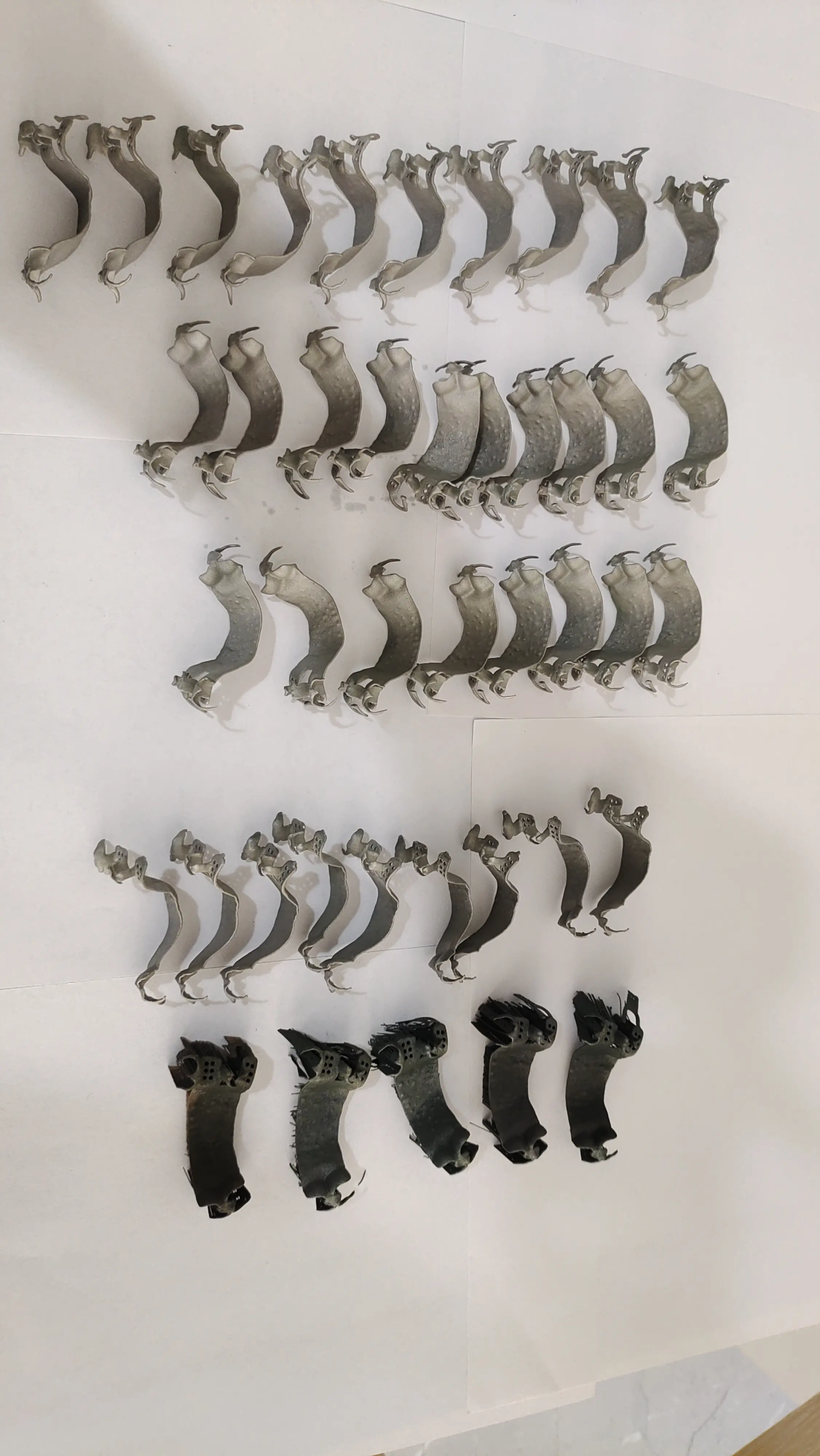
Despite the role of polymer parts (e.g., non-structural pipes), the harsh environments of F1 cars require high-performance metals. This is what technology likes Selective laser melting (SLM) shine. SLM uses high-power lasers to carefully fuse fine metal powders (such as titanium alloys, aluminum alloys, specific high-strength steels) layer by layer to build completely dense, robust and complex metal parts.
However, the part is not played directly from the printer. Post-processing is crucial:
- Support removal: Carefully remove the sacrificial support structure required during the printing process.
- Relieve stress: Heat treatment to eliminate internal stress.
- Surface finish: Process critical interfaces for aerodynamic polishing or applying specific coatings to resist wear or thermal management (e.g. EDM, polishing, tumbling, heat treatment). Achieving precise tolerances and perfect surface quality on internal channels or complex exterior surfaces requires expert finishing.
- examine: Strict CT scans, dimension inspections and metallurgical analysis ensure that parts meet F1’s extreme safety and performance standards.
Cooperation performance: Gremight Advantage
Meet the extraordinary demand for F1 grade 3D printed parts not only requires machines. It requires deep expertise, advanced technology and seamless production integration. Here, dedicated rapid prototyping and manufacturing partners become priceless.
Great Standing at the forefront of this demanding field. As a professional rapid prototyping manufacturer, Greverlight Leverages The most advanced SLM 3D printing equipment and the most advanced production technology. We focus on solving the challenges of rapid prototyping of complex metal parts, especially for high-performance applications where weight, strength and complex geometry are not negotiable.
Our expertise goes far beyond printing. We provide Comprehensive one-stop post-processing and sorting servicesunderstanding the journey from powdered metal to track-ready components requires careful care and precise machining capabilities. Whether it is achieving a perfect finish on aerodynamic components or ensuring dimensional accuracy of the critical suspension bracket, Greatlight’s integrated approach ensures quality.
We pride ourselves on flexibility and speed. Most materials from high-strength titanium and aluminum alloys to dedicated steel can be quickly customized and processed Meet strict project schedules. To customize precise machining and create mission-critical rapid prototyping sections, Greatlight has established itself as one of China’s major rapid prototyping partners, providing excellent quality at a highly competitive price.
Example: Agility factor: Imagine that the F1 team determined the efficiency of cooling inefficiency during practices on the game weekend. Using simulation data, engineers redesigned the vital internal coolant manifold. The design was sent to Greatlime. Print with SLM and prioritize quick completion, production in 24-48 hours, completing and delivering a fully functional precise metal part. It reached the qualifying track – a testament to the speed and ability of the modern AM partnership.
in conclusion
3D printing, especially metals like SLM, is not only a contributing technology in Formula One technology; it is a strategic priority. By authorized engineers to create lighter, stronger, more complex and iterative parts, AM provides a fundamental competitive advantage in its relentless pursuit of speed and efficiency. The integration of cutting-edge design software, advanced materials science, such as the material science of Greatlight processing, and exquisite printing/finishing technology, has fundamentally changed the way F1 cars are developed and manufactured. As AM machines get faster, materials become more advanced, and post-processing is more refined, we can expect its footprint on the grid to grow even more, thus breaking the boundaries of Motorsport’s peak.
FAQ About 3D printed F1 auto parts
Q1: What is the most common material used to 3D print F1 parts?
A1: Metals dominate, Especially high strength lightweight alloys such as titanium (Ti6al4v), aluminum (Alsi10mg, ScalMalloy) and specific grades of Maraging Steel. These provide the necessary strength-to-weight ratio, thermal resistance and durability. Certain high temperature polymers are used for lower thermal stress aerodynamic components.
Q2: Which 3D printing technology is most used in critical F1 metal parts?
A2: Selective Laser Melting (SLM)/Direct Metal Laser Sintering (DML) It is the main technology. It provides excellent mechanical properties and design freedom by fusing the fine powder layer by layer with the laser to create completely dense metal parts. Electron beam melting (EBM) is also used in some larger titanium components.
Q3: Are 3D printed parts powerful enough to achieve extreme forces in F1?
A3: Yes, when designed and manufactured correctly. SLM/DMLS parts can achieve material properties that are very close to their traditional alloy production, or in some cases exceeding their specific alloy. Strict testing and quality control, including CT scanning and mechanical testing, ensure that parts meet extreme safety and performance needs.
Question 4: How much time does 3D printing save for the F1 team compared to traditional methods?
A4: Saving time is considerable. It is usually possible to design, print, finish and qualify for complex parts (tools, machining, assembly) that have traditionally been manufactured for several weeks. This rapid turnaround of prototypes and production parts is invaluable during intense competition seasons, seasons for testing upgrades.
Q5: Why is post-processing so crucial for 3D printed F1 parts?
A5: The original version requires a major work. Support must be removed to relieve residual stress (via heat treatment), critical surfaces often require precise processing to achieve the required tolerances and finishes. The aerodynamic surface needs to be smooth, and the functional surface may require coating. Proper post-processing ensures functionality, reliability, dimensional accuracy and life.
Question 6: Can smaller racing teams or engineers access this technology?
A6: Absolutely. Although the F1 team has internal functions, a dedicated ecosystem Rapid prototype service providers, such as Greatlight Make high-quality metal accessible. Teams across Motorsport categories (FE, WEC, F2, F3, etc.) and even ambitious racing engineers leverage services that provide SLM/DMLS printing and expert finishes to gain a competitive advantage without having to make a lot of capital investments on the machine. Greatlight specializes in providing these precise custom metal parts for quick and cost-effectiveness.