Unleashing Efficiency: The Cutting-Edge World of 3D Printed Fan Blades
In today’s high-stakes engineering environment, thermal management is not just an afterthought, it is a critical bottleneck that determines system performance, efficiency and longevity. From aerospace turbines to silently running server farms, cooling solutions must continue to evolve or risk stifling innovation. The 3D printed fan blade is born: a fusion of precision design, advanced materials and disruptive manufacturing capabilities. Here’s how the technology is redefining thermal engineering.
Why traditional fan blades are reaching their limits
Traditional blades (machined, cast or molded) inevitably come with compromises:
- Rigid design: Forming/machining of complex geometries (organic curves, internal ducting, variable thicknesses) is expensive or impossible.
- Material limitations: Lightweight composites or high-temperature alloys face manufacturing hurdles.
- Prototyping delays: Month-long delivery times hinder iterative improvements.
The 3D printing revolution: Beyond the hype, towards ultra-high efficiency
Additive manufacturing (AM) removes these walls by using lasers, powders and data-driven algorithms to build the blades layer by layer. Payback? Complete upgrade of performance indicators:
1. Perfect aerodynamics
- Reduce weight: Topology-optimized lattice reduces mass by 15-40%, thereby reducing inertial loads and power consumption.
- Process optimization: Bionic nodules (whale fin ridges) or multi-curvature airfoils can increase airflow by 8-12% while eliminating harmonics.
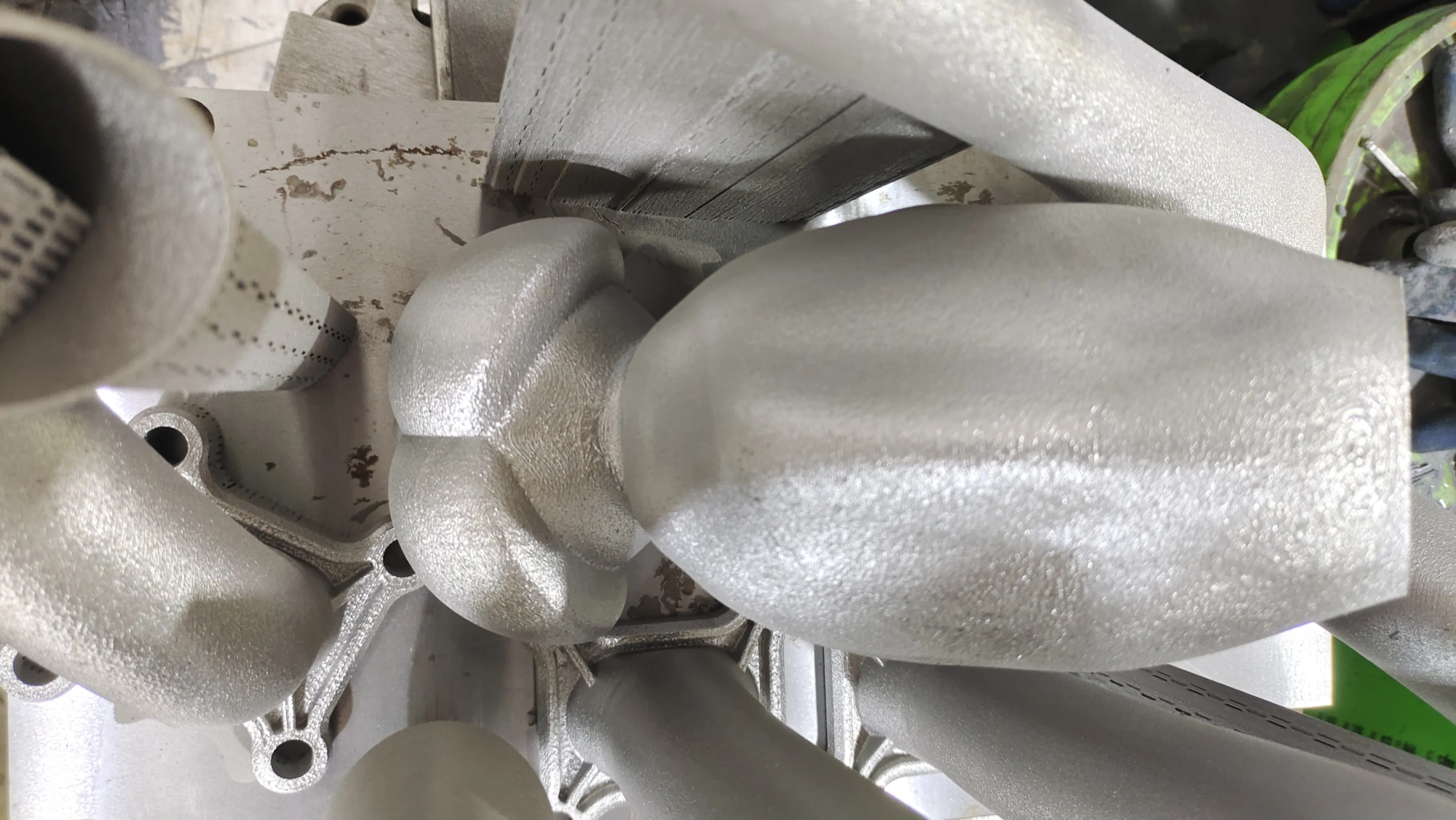
- Embedded cooling: Prints hollow structures with spiral internal ducts that actively circulate coolant in high-heat areas such as turbine blades.
example: Jet engine blades integrate micro-channels for convection cooling, allowing the operating temperature to be reduced to 150°C, thereby extending service life.
2. Materials designed for extreme environments
Additive manufacturing unlocks exotic alloys and polymers beyond the reach of traditional methods:
- Titanium (Ti-6Al-4V): Unmatched strength-to-weight ratio in aerospace/defense.
- Aluminum silicon (AlSi10Mg):Ideal heat pipe for electric vehicle battery cooling.
- PEEK and PEKK polymers: Chemically inert, heat-resistant blade for use in laboratories or corrosive environments.
Fun fact: SLM-printed Inconel 718 is capable of withstanding temperatures in excess of 750°C, which is critical for the intake of scramjet engines.
3. Release speed and accuracy
- rapid prototyping: Test functional prototypes in days instead of months – speeding up development ten times.
- Digital twin verification: Simulate fluid dynamics/stress distribution forward Printing starts.
- Mold-free production: Economical for low-volume batches (10–500 units), no tooling required.
Behind the print: SLM technology and post-processing capabilities
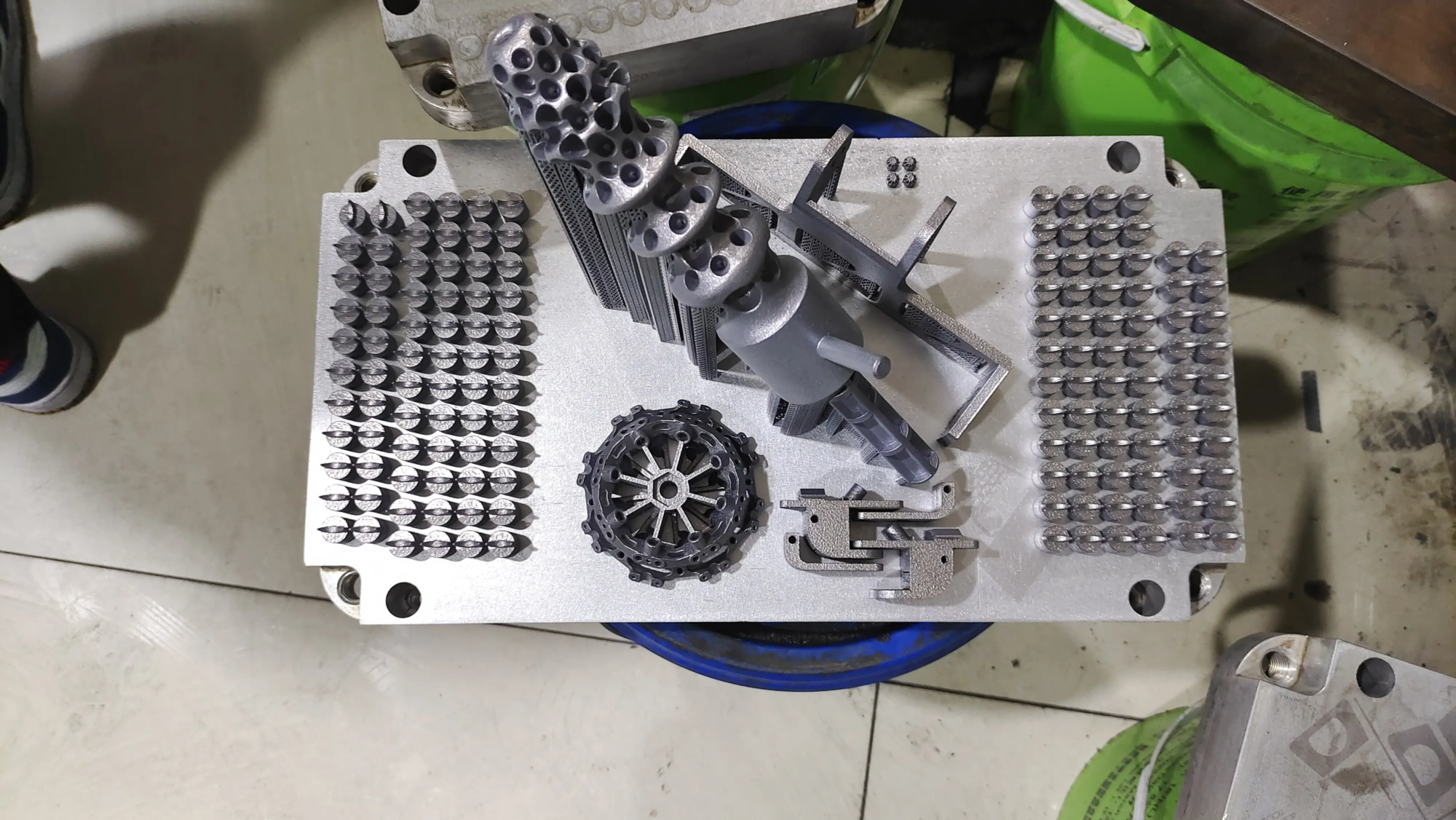
At GreatLight, metal blades use state-of-the-art technology Selective Laser Melting (SLM) Workflow:
- Laser precision: A 400–1,000W laser melts micron-thick layers of metal powder in an inert argon gas chamber.
- stress management: Predictive algorithms calibrate laser speed/power to avoid thermal distortion.
- Rigorous post-processing: Electrochemical polishing (ECP) smoothes the surface to Ra 0.8μm; CNC micro-machined balance hub; Hot isostatic pressing (HIP) eliminates pore traps.
result? The integral blade density is >99.7%, the tolerance is within ±0.05mm, and the fatigue strength is comparable to that of forgings.
Practical applications drive adoption
- aerospace: GE Aviation’s 3D printed turbine blades can reduce fuel consumption by 15% for next-generation LEAP engines.
- Electric vehicle thermal system: Variable-pitch aluminum blades cool 800V battery packs without making noise.
- Quantum computing: Micro PEEK fans dissipate server heat to less than 30dB, critical for noise-sensitive labs.
- HVAC 2.0: The turbine impeller transforms the traditional system and reduces energy consumption by 21%.
Eliminating Doubts: Confronting the Challenges of Additive Manufacturing Head-on
Myths about additively manufactured inserts persist. Let’s reveal it:
- "they break easily": HIP post heat treatment ensures