Beyond the mold: How 3D printing is reinventing the humble O-ring (and when it makes sense)
O-rings have been the unsung heroes of engineering for decades. These simple ring seals quietly prevent leaks and maintain pressure in systems ranging from faucets to rocket engines that have traditionally relied solely on molded rubber. Traditional manufacturing, while very efficient, has limitations: special-purpose tooling, minimum order quantities, long lead times, and inflexible designs. Enter the era of 3D printing – not necessarily to replace molded elastomers overnight, but to carve out an important niche where flexibility, speed and customization are critical.
This guide cuts through the hype and looks at the reality of 3D printed O-rings, exploring their materials, benefits, limitations, ideal applications and the complex technology that makes them possible.
Why Consider 3D Printing O-Rings?
It’s easy to turn away from additive manufacturing because it’s such a common and cheap component. However, several compelling scenarios make 3D printing a wise choice:
- Rapid prototyping and design verification: Iterative seal design Hournot weeks. Immediately test different cross-sections (round, square, X-ring), sizes and hardnesses with functional prototypes under real operating pressure. Detect sealing defects early.
- Short run production and customization: Does traditional equipment require special seals? Need a miniaturized seal that cannot be molded? Desperately need a unique durometer (hardness) or non-standard sizes? 3D printing eliminates expensive molds (typically $5,000 to over $50,000) and minimum order quantities. One-off or small batch production is economically feasible.
- Integrated design: Design seals as part of Larger 3D printed components eliminate assembly steps and potential leak paths at interfaces. Print gaskets directly onto housings or within complex geometries.
- Exotic material exploration: Seals can be easily prototyped using specialty materials (high-temperature resins (PEEK, PEKK) or unique elastomers) before using expensive tooling.
- Reduce inventory: Maintain digital designs and printed seals precisely when needed (manufacturing on demand), dramatically cutting warehousing costs and eliminating obsolete inventory.
Material Dilemma: Not All Elastomers Are Created Equal (or Printable)
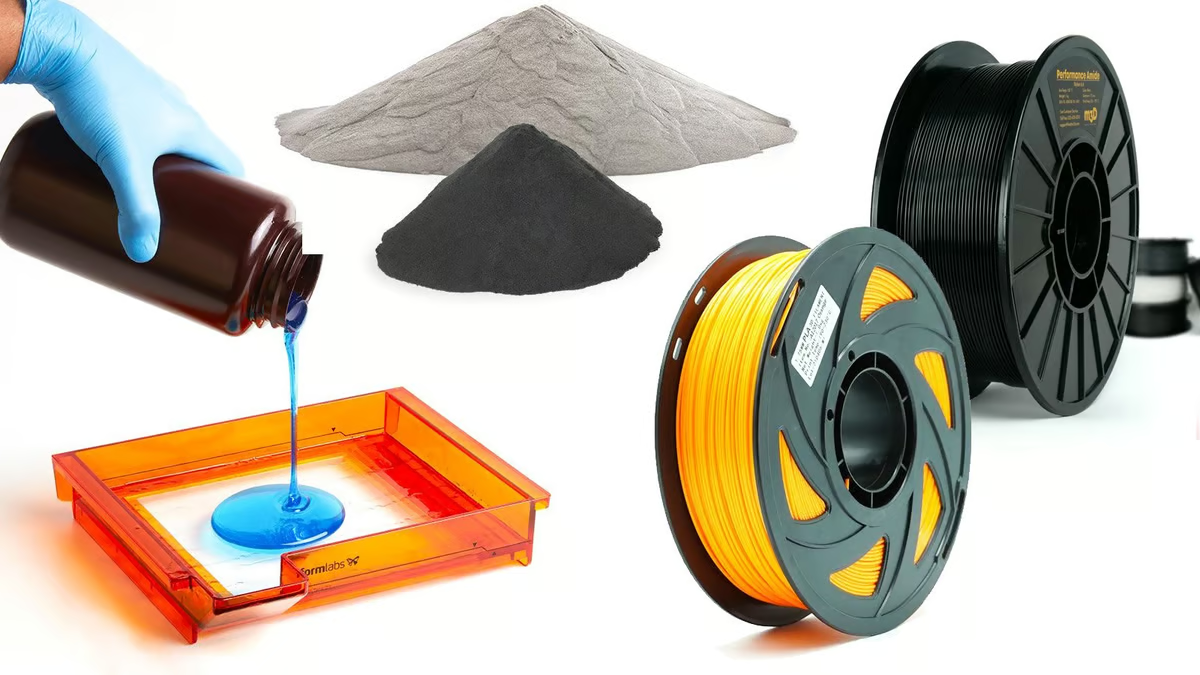
Performance depends entirely on material selection. Achieving true elastomer performance through 3D printing comparable to Nitrile Butadiene Rubber (NBR), Fluoroelastomer™ (FKM) or silicone is challenging but requires continuous improvement. Key technologies and materials include:
-
Material extrusion (FDM/FFF):
- Commonly used materials: Thermoplastic polyurethane (TPU), thermoplastic copolyester (TPC), flexible PLA/PETG blends.
- advantage: Easy to use, has good overall flexibility, and is cost effective for large prototypes/low stress applications.
- shortcoming: Significant anisotropic properties (strength varies with print direction), visible layer lines affecting surface sealing, lower heat/chemical resistance compared to molded rubber, limited fine detail/tiny dimensions.
-
Material jetting (PolyJet/SAF):
- Commonly used materials: Photopolymer resins that simulate various elastomers (rubber-like Agilus™, digital ABS, etc.).
- advantage: Exceptionally smooth surface finish, excellent detail resolution (tiny seals), ability to create multi-material parts (rigid bodies with soft seals), simulate various hardness testers.
- shortcoming: Compared to molded rubber, elongation at break is generally lower, compression set is higher, maximum temperature resistance is lower, and it gradually degrades under UV exposure/weathering.
- Powder Bed Fusion – Selective Laser Sintering (SLS):
- Commonly used materials: TPU powder (such as TPU 88A, TPU 95A).
- advantage: Excellent isotropic mechanical properties (consistent strength in all directions), higher durability and elasticity than FDM/PolyJet, good chemical resistance, relatively good surface finish, no support structure required.
- shortcoming: Compared with TPU, rare elastomer powder is not easy to obtain, the surface is usually rougher than PolyJet/Vat Poly, and the cost is higher than FDM.
Core challenge: sealing performance
Turn flexible printed rings into reliable Sealing requires overcoming inherent manufacturing barriers:
- Anisotropy: Especially important for FDM. The seal must withstand radial and axial forces evenly. Poor layer adhesion can significantly weaken the seal in one direction.
- Surface finish: Visible layer lines or powdery surfaces can create microleakage paths. Specialized post-processing (vapor smoothing of FDM thermoplastics, sandblasting/tumbling of SLS parts) is often critical for critical seals.
- Material properties: accomplish simultaneously High elasticity, low compression set, good tear strength and temperature/chemical resistance matching industrial elastomers remain elusive most 3D printing process and materials. Careful selection and reference to actual material data sheets under expected conditions is critical.
- Valley of Disappointment: Beware of vendor claims "Rubber equivalent" There is no verifiable performance data. 3D printed elastomers often fall short, especially under sustained high pressure/high temperature/extreme dynamic use.
GreatLight: Engineering Excellence for 3D Printing Functional Prototypes and Seals
exist huge lightwe understand the critical interplay between material science, advanced printing technology and meticulous post-processing to create functional 3D printed seals that meet demanding requirements. Take advantage of our state-of-the-art technology Selective Laser Melting (SLM) and polymer printing capabilities and expert engineering consultation, we meet the challenges head-on:
- Materials expertise: We help navigate the complex world of printable elastomers and high-performance polymers. We source proven TPU powders, high-temperature resins and other specialty materials for SLS (ideal for seals), providing transparent data for informed decisions.
- SLS advantages: Our laser sintering technology unlocks the full potential of materials like TPU. We achieved a nearly isotropic part with excellent mechanical properties, which are critical for strong seals, fine details and complex geometries.
- Precision post-processing: Successful sealing usually requires a flawless surface. We utilize advanced technologies such as vapor smoothing (for certain polymers), precision media blasting and specialty coatings to dramatically improve surface finish and seal integrity.
- Design for Additive Manufacturing (DfAM): We work closely to optimize seal geometry and orientation for printability and performance. Can it be integrated? Can the profile be optimized for sealing? Is vacuum sealing required?
- One-stop solution: From digital design and rapid prototyping to functional verification testing, material selection, post-processing and low-volume production, GreatLight provides integrated rapid prototyping and manufacturing services.
Conclusion: ideal application
3D printed O-rings shine best in the following scenarios:
- Prototyping: Verify designs and functionality faster than ever before.
- Small batch/customized machinery: Used equipment, specialty instruments, custom fixtures/jigs. Quick turnaround for niche needs.
- Static seal: Applications with moderate pressure cycles without excessive slip/friction.
- Non-critical environment: Under extreme conditions (temperature, pressure, chemicals) absolute tightness is not of paramount importance. Think pneumatic prototypes, low pressure fluids, dust seals.
- Integrated components: Functionality is built directly into the component.
- Miniaturization/Microfluidics: Where micromolding is impractical or prohibitive.
Conclusion: A powerful tool in your sealing tool kit
3D printed O-rings are not a complete replacement for traditional molded rubber seals, especially in high-stress, high-temperature or mission-critical applications that require decades of reliable service. Currently, the challenge of achieving equivalent compression set, ultimate elasticity, and extreme environmental resistance remains a significant obstacle for many printable materials.
However, as solution Rapid prototyping, functional testing, customization, low-volume production and integrated sealing elements, 3D printing offers unique and valuable benefits. It significantly reduces time to market, enables unprecedented design freedom, resolves obsolescence issues, and provides cost-effective solutions to unique sealing challenges not possible with traditional methods. The key is understanding material limitations, choosing the appropriate printing technology (SLS is our recommended mainstay), applying expert post-processing, and setting realistic performance expectations.
Work with an experienced rapid prototyping provider such as huge lightleveraging state-of-the-art SLM equipment and deep materials processing expertise, ensures you go beyond theoretical potential to obtain practical, functional sealing solutions that are precisely tailored to the unique needs of your project.
Frequently Asked Questions About 3D Printed O-Rings
-
Can 3D printed O-rings withstand high temperatures like Viton™?
- Generally speaking, not yet. Although high-temperature polymers such as PEEK or PEKK-FR can be printed, considerable elasticity, compression set, and Simultaneous achievement of thermal stability (250°C+ continuous) of Viton™ FKM remains elusive with current printing technologies. The maximum temperature for TPU-based SLS parts is typically around 80-100°C; some photopolymers are slightly higher. Be sure to check the specifics Printed Material Data Sheet with your operating temperature.
-
Are 3D printed O-rings cheaper than molded O-rings?
- For customization/small batch, Absolutely. Eliminating expensive molds can save thousands of dollars. For large-scale production (>10,000+ parts), the unit cost of molded rubber remains low. The cost equation changes significantly based on volume and uniqueness.
-
Are seals really leak-proof?
- along with Correct technology (especially SLS) and careful post-processingfor functional sealing in low to medium pressure static applications. accomplish vacuum seal Sealing or sealing under extreme dynamic loads/wear is more challenging and requires rigorous testing.
-
Can I 3D print very small O-rings?
- Yes! Technologies such as material jetting and high-resolution SLS machines excel at producing tiny O-rings whose intricate details cannot be reliably molded. This is the main advantage of additive manufacturing of seals.
-
How does compression set compare to molded rubber?
- Compression set (permanent deformation after compression) is a critical weakness most Printed elastomers. Under sustained load, they tend to lose elasticity more quickly than premium molded rubbers, potentially causing seal failure more quickly. Material selection and minimizing sustained stress are critical.
- Is TPU the best material for printing O-rings?
- For functional seals using current mainstream additive technologies, TPU processed through SLS provides the most balanced elastomer properties – Reasonable elasticity, good tear strength, chemical resistance relative to alternatives,