Beyond Sci-Fi: How 3D Printing Could Create Real-World Transformers
Remember those Transformers-inspired childhood dreams of robots that could seamlessly switch between different forms to adapt to any situation? While we may not be building sentient Autobots to fight the Decepticons, the fusion of advanced robotics and revolutionary 3D printing brings us closer than ever to creating functional, multi-purpose Autobots. "Transformers" for real-world applications. These are not just toys; they are toys. They are complex machines designed to revolutionize tasks from complex manufacturing to disaster response and specialized healthcare.
Evolution: From static robots to shape-shifting machines
Traditional robotics excels at repetition. They perform predefined tasks with incredible speed and precision. But real-world environments are chaotic and unpredictable. This is the concept of shape-shifting robots—or "Transformers" Inspired by the adaptability of nature, these robots can significantly change their physical structure to perform different functions: a drone that folds into a cargo crawler, a robotic arm that reconfigures into a stable platform, or a medical probe that transforms according to different procedures.
challenge? Building complex joints, lightweight yet strong components, and internal mechanisms that can dynamically reconfigure has historically been expensive, time-consuming, and technically demanding. This is where additive manufacturing (AM), primarily metal 3D printing, becomes a game changer.
The technology behind transformation: SLM and beyond
Creating complex, shape-shifting robots requires the following components:
- Geometrically complex: Internal channels for wiring/cables, embedded sensors, hollow lattice structures, and custom hinge mechanisms are often not achievable through subtractive methods. 3D printing builds layer by layer, freeing design from traditional constraints.
- Sturdy and lightweight: Transformers require strength at the connection points and rigidity of the structural elements, but total mass must be minimized for efficient movement and energy consumption. Advanced lightweight lattice structures can only be manufactured additively.
- Integrated features: Components with combined structural and functional properties, such as integrated cooling channels near the actuator, can be realized in a single print.
- custom made: Each conversion sequence is unique. Mass production is not suitable; each robot component usually requires a custom design.
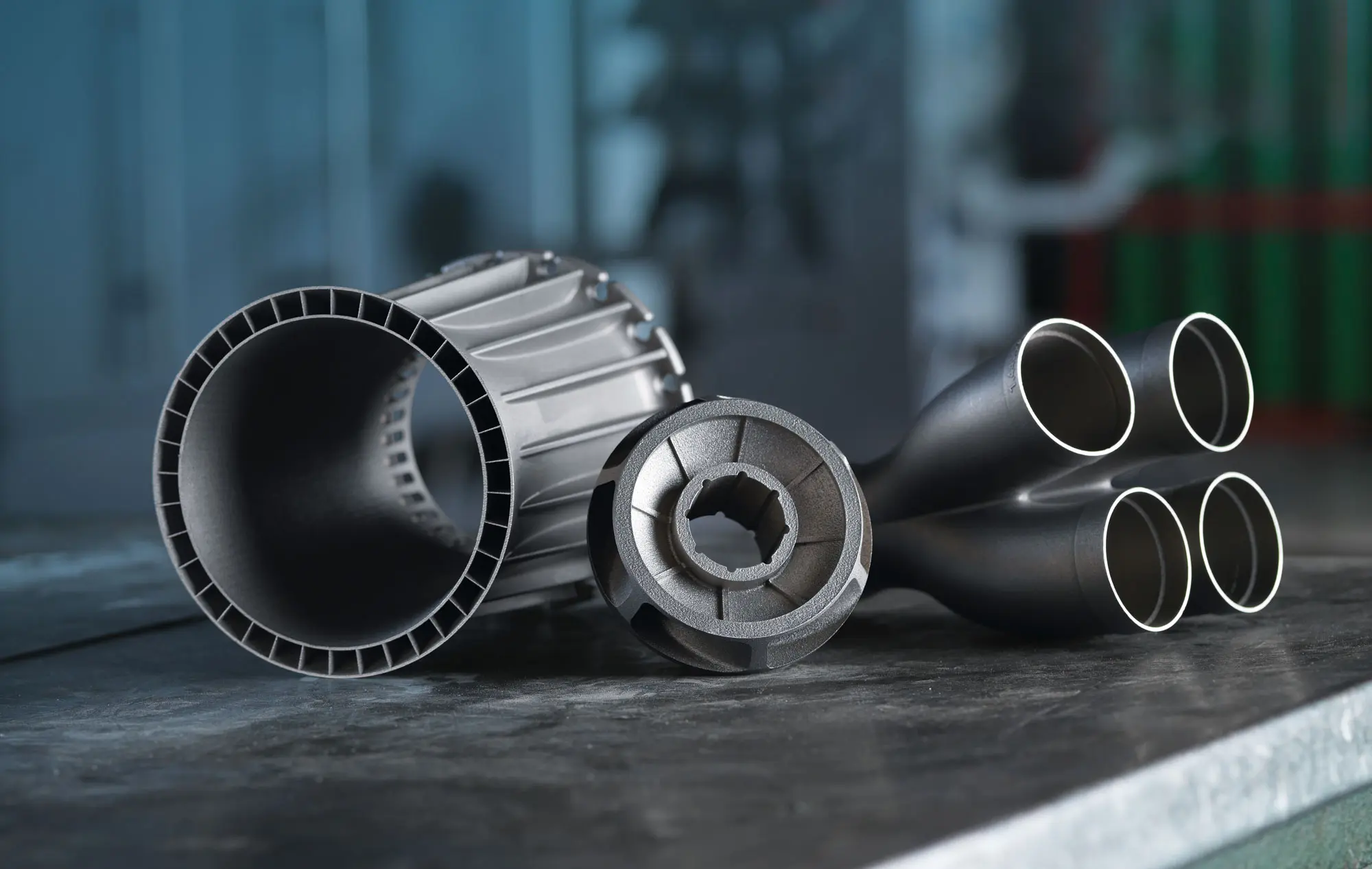
Selective Laser Melting (SLM), The premier metal 3D printing technology at the cutting edge. It uses high-power lasers to selectively fuse fine metal powder particles (such as titanium, aluminum, stainless steel, Inconel) into fully dense parts. SLM excels in producing the complex geometries, internal features and high strength-to-weight ratio necessary for functional transformers.
Other technologies such as multi-jet fusion (MJF) or stereolithography (SLA) often play a crucial role in the rapid prototyping of durable polymer housings, flexible joints or non-load-bearing components. However, SLM remains the cornerstone of the core skeleton and metal-bearing mechanism, enabling robust transformation.
Why 3D printing is a key enabler:
- Unleash design freedom: Create previously unimaginable geometries – compliant mechanisms, optimized hinges, internal channels – packed into compact spaces.
- Performance optimization: Consolidate multiple parts into a single, stronger assembly, reducing points of failure and weight. Precisely optimize the topology where stress occurs.
- Rapid iteration and prototyping: Test complex conversion mechanisms quickly and cost-effectively. Fail faster, learn faster, and optimize designs iteratively—this is critical for novel robotics concepts.
- Mass customization: Economically produce small batches or unique robot variants, customizing the Transformer for a specific niche without high tooling costs.
- Material Versatility: Utilize engineering-grade metals and polymers optimized for strength, wear resistance, thermal properties, or biocompatibility depending on the application.
Potential applications: Where transformers will appear
- Search and Rescue: The robots transform from flying drones into crawling or climbing machines to navigate complex rubble environments inaccessible to humans or single-form robots.
- Advanced Manufacturing: Robotic systems reconfigure on demand to handle different assembly tasks, tool setups or inspection requirements, maximizing flexibility in low-volume production.
- Space exploration: The compact robot launches as a single unit and can unfold or transform into complex structures, exploration drones or robotic arms on distant planets.
- Minimally invasive surgery: Microrobots can be deployed through tiny incisions that deform within the body to perform complex surgical procedures or targeted drug delivery.
- Infrastructure inspection/maintenance: The robots transition from flying around bridges to crawling along girders for detailed inspections or repairs.
Overcoming the Challenge: Precision and Integration
Building a transformable robot isn’t without its hurdles:
- Ultra-precision moving parts: Joints, bearings and sliding mechanisms require micron-level precision for smooth, friction-free transitions – something only high-end SLM machines and careful design can achieve.
- Material properties: Components must be able to withstand repeated conversion cycles without fatigue or failure. Material selection, heat treatment and precise printing parameters are critical.
- Integration complexity: Combining printed components with motors, sensors, electronics and control systems into a seamless, reliable system requires deep multidisciplinary expertise.
- Post-processing expertise: Support removal, complex machining of critical interfaces, heat treatments and specialized surface finishing such as smooth internal channels or hardened wear surfaces are critical to functionality and longevity.
GreatLight: Working with pioneering futuristic robots at the speed of thought
At GreatLight, we don’t just make parts; we make parts. We help engineers transform transformative robotics concepts into functional prototypes and production-ready components. Our core expertise is perfectly aligned with the needs of building the next generation "transformer" robot:
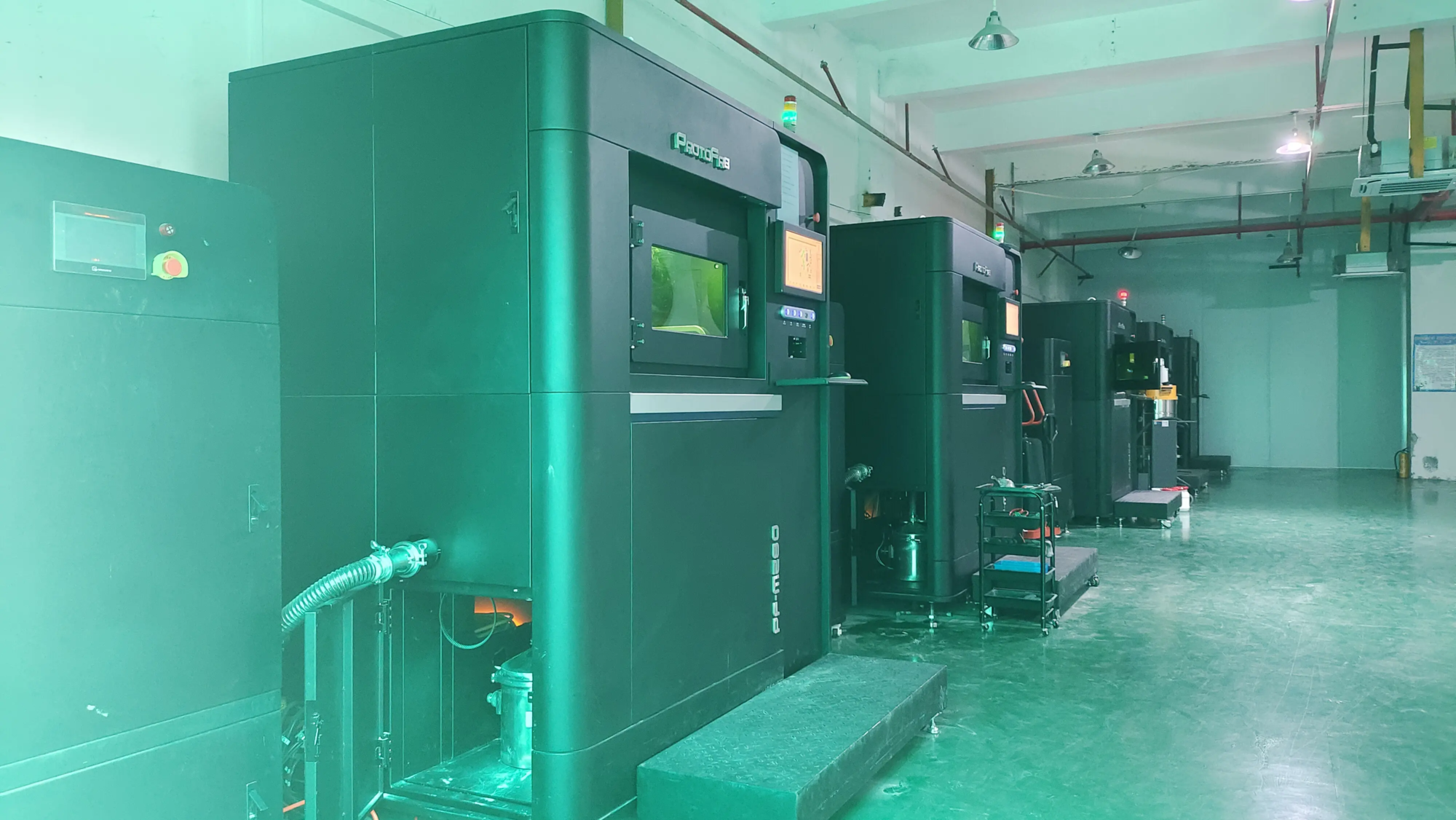
- Advanced SLM Power Source: We are equipped with cutting-edge selective laser melting printers that can process a variety of aerospace-grade alloys (titanium Ti6Al4V, aluminum AlSi10Mg, stainless steel, Inconel) that are essential for strong, lightweight metal skeletons and complex mechanisms.
- Excellent rapid prototyping: Need to test a complex transformation sequence next week? We specialize in transforming complex CAD designs into high-fidelity metal prototypes faster than traditional methods, significantly shortening your development cycle.
- Engineering expertise: Our team understands the stresses involved in robot kinematics and deformation systems. We work together to improve printability, performance and integrated designs to effectively solve complex rapid prototyping challenges.
- One-stop precision processing: Transforming printed parts into fully functional robotic parts requires more than just printing. We offer comprehensive post-processing: professional CNC machining for critical interfaces, meticulous support removal, EDM for difficult geometries, precision surface finishing (polishing, coating), heat treatment and rigorous inspection (CMM, CT scan) – all under one roof.
- Materials and Customization Flexibility: We support customized cores. Is a specific alloy required? Need unique dimensional tolerances? Need a quick turnaround? GreatLight provides tailor-made solutions to meet the needs of your specific Transformer project, on time and at competitive prices.
We help roboticists push the boundaries because we know their most complex deforming parts will be manufactured accurately and reliably.
Conclusion: The transformation has begun
The era of static, single-purpose robots is giving way to a more dynamic future. 3D printing, and SLM in particular, is the catalyst for the creation of truly shape-shifting robots – versatile, adaptable machines capable of tackling challenges we can only currently imagine. From saving lives in disasters to building infrastructure on Mars, the applications are limitless.
While the journey involves solving complex engineering puzzles, the path is clear. It is critical to adopt advanced additive manufacturing with a partner with deep expertise in rapid prototyping, precision metal fabrication and robust post-processing. Tomorrow’s robots will no longer be just tools; They will be adaptable partners, providing transformative capabilities across industries.
Ready to build your own robotic future?
Learn how GreatLight’s advanced SLM 3D printing, precision machining and turnkey finishing services can accelerate your deformable robot development. Customize your precision rapid prototyping parts today at the best prices!
FAQ: 3D Printing Transformers Revealed
- Q: Are these Transformers like the ones in the movies?
A: While inspired by this concept, real-world shape-shifting robots focus on utilitarian functions rather than sentient beings. They physically morph between different configurations to efficiently perform multiple tasks. Imagine advanced drones becoming crawler robots or modular robotic arms that automatically change tool sets.
- Q: Why is metal 3D printing (especially SLM) so important?
A: SLM excels at producing complex internal features, complex geometries (e.g. internal lattice, hidden channels) and the excellent strength-to-weight ratio required for compact load-bearing metal frames and mechanisms to achieve reliable conversions. It provides unparalleled design freedom and manufacturability for these unique parts.
- Q: Can 3D printing handle moving parts and joints?
Answer: Of course. High-precision SLM and meticulous post-processing, including CNC machining of critical interfaces and precise surface finishing, allow the creation of hinges, sliders, bearings and compliant mechanisms with the precision, smoothness and durability required for repeated conversion cycles.
- Q: What are the main challenges in building 3D printed Transformers?
A: Key challenges include designing reliable transformation kinematics, ensuring material fatigue resistance over thousands of cycles, integrating sensors/actuators into complex printed structures, achieving sub-assembly accuracy, and managing the sheer complexity of the overall system. Expertise in design, materials science and advanced manufacturing is critical.
- Q: How quickly can I get parts for my prototype Transformer robot?
A: Work with a professional rapid prototyping partner, e.g.