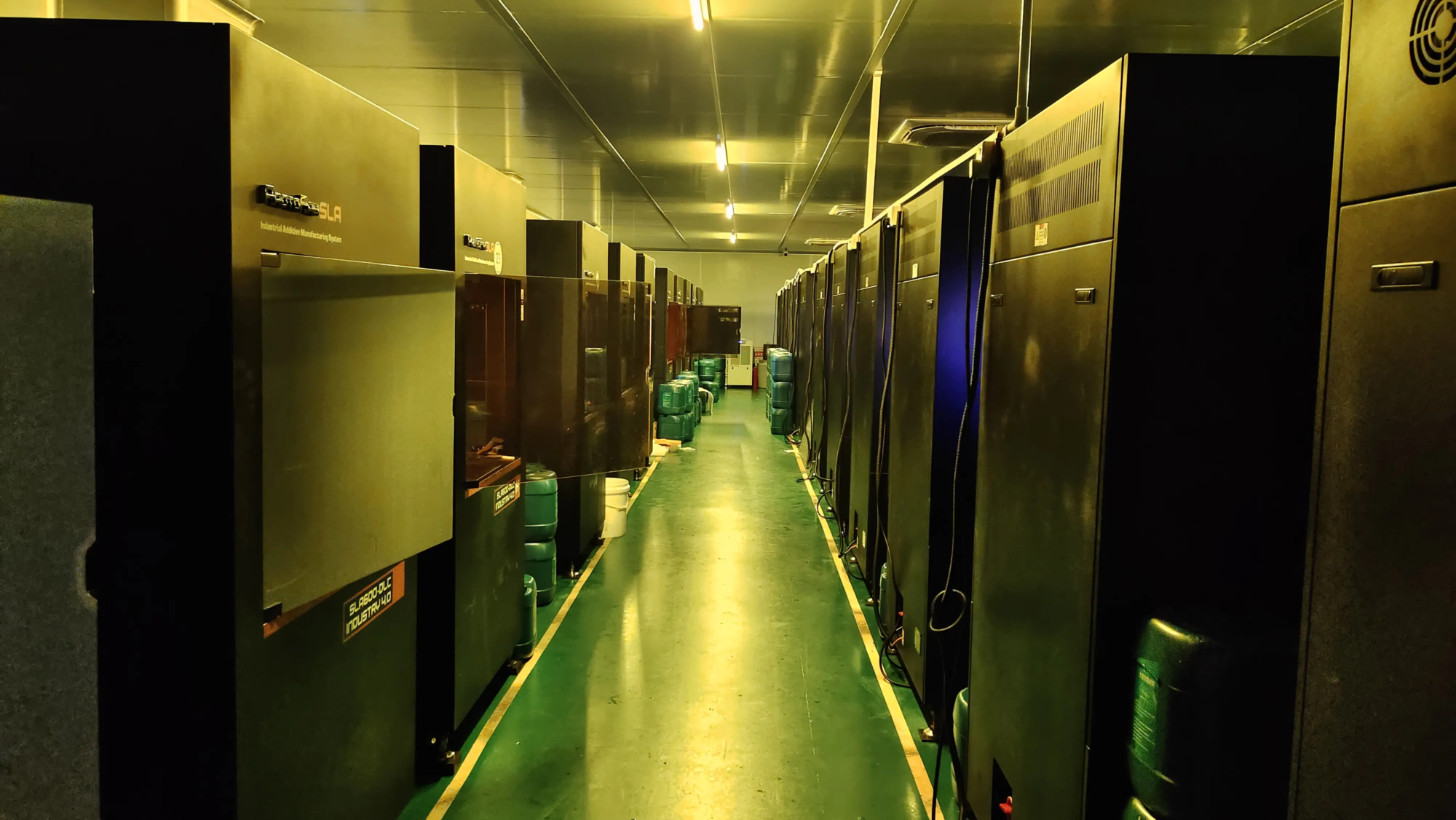
The era of large-scale innovation: 600mm 3D printing unleashes potential
Imagine seamlessly producing full-size automotive components, complex aerospace fixtures, or large building models in a single printing cycle. This is no longer a futuristic fantasy – it’s a real reality to unlock the 600mm 3D printer. At Greatlight, as a leader in the field of specialized rapid prototyping and manufacturing, we recognize that the size limits severely limit design freedom and productivity. Our investment in large powder bed fusion technologies, especially advanced selective laser melting (SLM) systems, with a build volume of 600mm (x, y and Z), represents a paradigm shift. This blog studies why "big" It’s really better in industrial additive manufacturing, and how it can transform complex prototypes into simplified processes.
Break the Size Barrier: Why 600mm Build is Important
Traditional 3D printers often force engineers to design tradeoffs – splitting most of them, slashing structures with keys, and extending the schedule through assembly steps. The 600mm cube build volume exceeds these limitations:
- An unprecedented partial merger: Design complex components as a single unified component. This eliminates weak joints, simplifies supply chains, reduces potential failure points (such as fasteners), and significantly reduces assembly time and costs. Structural integrity and performance advantages of aviation pipelines, automotive mounts, and industrial tools.
- Real large-scale prototype: The actual expected size of the prototype design. No scaling or slices impair structure or functional test effectiveness. Verification form, fit and function accurately fit large end-use parts.
- Fundamentally improves productivity: Print large parts or large numbers of smaller parts at the same time. This significantly reduces lead time compared to sequential printing, maximizing machine uptime and improving ROI.
- Unlock new design geometry: Enables an organic, topologically optimized design with complex internal functions that cannot be reliably fit or manufactured in smaller interiors. It was impossible to produce lightweight, high-strength structures before.
The convergence of scale and precision: Advanced SLM technology
Size alone is not enough. Greglight Loverages state-of-the-art Selective laser melting (SLM) Technology in these large rooms. This is crucial for rapid metal prototyping:
- Outstanding material properties: SLM uses a high-power laser to fuse fine metal powders such as titanium alloys, aluminum alloys, stainless steel, inconel and tool steel to fuse them layer by layer into fully dense functional metal parts. The final part usually has mechanical properties, usually equivalent to or equal to the forged material, making it suitable for demanding applications.
- Excellent resolution and details: Although the construction area is large, accuracy is not sacrificed. Advanced laser scanning systems and optimized process parameters ensure fine feature resolution, excellent surface quality (as at bones) and tight tolerances, even on complex large geometries.
- Repeatability and quality control: An integrated process monitoring system ensures consistent melt pool behavior and layer quality throughout a wide range of build volumes, which is critical for industrial production reliability.
Solve core rapid prototyping challenges
The 600mm SLM printer directly solves the persistent pain points in metal prototypes and low-volume production:
- Speed to functional parts: Merge design iteration cycles. Production of large, complex functional prototypes in hours/days rather than weeks/months. Acceleration from CAD to physical verification will greatly shorten the development timeline.
- Reduce costs through mergers: Eliminate tool and assembly costs. Integration usually greatly reduces the number of parts, assembly labor and inventory. Large-capacity batch printing reduces the cost per portion of the prototype or end-use parts.
- No compromise complexity: Designed with internal channels, lattice or organic shapes, machining or casting with CNC (or found to be very expensive), especially on large scales.
- Material and design flexibility: Quickly switch materials without changing tools. Iterate design seamlessly between builds – invaluable for R&D and customized solutions.
Beyond the Construction: One-stop Precise Complete
Greatlight understands that the work is not completed after the print is completed. Large metal parts usually require a lot of post-processing. We provide comprehensive One-stop post-processing and completion serviceprofessionally adapted to the challenges of substantive architecture:
- Support removal: Careful manual or automatic removal of support structures is essential for large and complex geometries.
- Relieve stress: Critical heat treatment to minimize internal stress on large solid metal slices.
- Precision machining: CNC machining, used for critical interfaces, threading and tight tolerance features directly on the printed section. Our expertise ensures alignment and accuracy after any thermal effects.
- Surface reinforcement: A range of options: bead blasting, grinding, polishing, foaming and dedicated coatings to achieve the desired aesthetic and functional surface properties.
- Non-destructive testing (NDT): Ensure the integrity of parts for critical applications through X-ray (CT scan) and dye penetrant inspection is especially important for large or critical critical components.
Material versatility: Catalytic custom solutions
"Most materials can be customized and processed" More than just a claim – this is our operating standard. Whether you need industry-standard alloys or specialized grades to meet specific performance needs (high temperature, corrosion resistance, biocompatibility, unique mechanical properties), we collaborate to establish reliable printing parameters as your unique material needs in large SLM systems, resulting in fast knobs with fast turning points, precise parts.
Why Greatlime is your partner for large metal innovation
As one of the major rapid prototyping companies from China, Greatlight combines state-of-the-art technologies such as our 600mm SLM platform with deep engineering expertise. Our commitment is not only to print; We work with you to overcome manufacturing barriers, unlock design freedom with large AMs, cut development time and reliably produce high-performance metal components. We bridge the gap between ambitious design concepts and manufacturable reality.
in conclusion
600mm 3D printers, especially those using advanced SLM technology, far outweigh larger machines. This is a catalyst for innovation. It removes the constraints of small build volumes, allowing engineers and designers to think differently – bigger, bolder, more integrated. Greglight is at the forefront of this revolution, providing not only large-scale printing capabilities, but also a complete ecosystem including advanced hardware (such as our SLM systems), deep material knowledge, precise post-processing and dedicated engineering support. We empower the industry from aerospace and automotive to energy and heavy industry to create large, complex, high-performance metal parts faster and more efficiently than ever before. Stop compromise with small-scale solutions. Unleash your biggest, most ambitious designs – Contact Greatlight now to discuss your custom precision rapid prototyping project and experience the capabilities of 600mm SLM printing!
FAQ (FAQ)
-
Q: Which type of metal parts is best for 600mm 3D printers?
one: Ideal applications include large structural aerospace components (brackets, frames, pipes), automotive/sub-assemblies (chassis parts, large housings), industrial tools (clips, fixtures, molds of composite materials), energy sector components (heat exchangers, heat exchangers, parts, turbine parts) and system models or engravings. Essentially, any large, complex or combined metal part benefits a lot. -
Q: How does the cost of large SLM printing compare to traditional manufacturing industries with large parts?
one: For prototypes, complex geometry or low to neutral yields, large SLMs are often highly competitive or superior. It eliminates custom tooling/forming costs, reduces part counting/assembly costs by combining and minimizes material waste (near mesh shapes). For very simple large parts, the traditional approach may be cheaper, but for complexity and customization, SLM wins. -
Q: Are the parts from large SLM printers sufficient for end-use applications?
one: Absolutely. SLM produces nearly density (usually > 99.5%) metal parts with excellent mechanical properties that can be comparable to, sometimes even, over, applied or forged equivalents after proper heat treatment. Post-processing such as hip joints (thermal isometric pressure) can further enhance the characteristics of key applications. -
Q: How long does it take to print 3D printed parts with a full 600mm volume?
one: Build time depends largely on part complexity, density and required mass/surface finish. Simple, solid metal blocks may be less than 48 hours. Highly complex, complex lattice structures may last 5-7 days or more. We optimize parameters to balance the speed and quality of your specific parts. -
Q: What is the biggest challenge facing large SLM parts?
one: The main challenges include Thermal stress/deformation (Relieve through optimized support, scanning strategies and stress-relieving heat treatments), Support deletion/post-processing (Expert manual/intervention combined with dedicated large-scale equipment) and Consistent quality assurance (Strong process monitoring and large NDTs (such as CT scans). Our advanced systems and extensive expertise are customized to overcome these obstacles. -
Q: Can Greatlight be printed with materials other than ordinary aviation alloys (such as tool steel or copper)?
one: Yes, we offer a wide range of material features. In addition to ordinary alloys (Ti6al4v, Alsi10mg, 316L, Inconel 718/625), we specialize in dealing with harsh materials such as thermal working tool steel (H13), Maraging Steels and Copper Alloys. We actively develop parameters for customized materials. - Q: What file formats do you need and how do you get most of my quotes?
one: We accept standard CAD formats such as Steps (.STP), IGES (.IGS), and SOLIDWORKS PART FILES (.SLDPRT). For best results, provide a watertight 3D model. Visit our website to upload your design for instant quotes, or contact our engineering team directly for complex projects that require consultation. We focus on delivery The best price and the best ability.