Pushing the limits: How 3D printing is building the next generation of combat robots
The arena roars and sparks fly as armored titans clash in a symphony of controlled chaos. This is BattleBots, the pinnacle of robotic combat sports, a marriage of engineering ingenuity and raw power. Success depends on pushing materials and design to their limits. In this high-stakes arena, 3D printing (Additive Manufacturing – AM) has rapidly evolved from a novelty to an indispensable weapon in the arsenal of combat robot builders, revolutionizing the way destructive robots are conceived, prototyped and perfected.
Break with tradition with additional layers
Traditional manufacturing methods—CNC machining, sheet metal fabrication—have long served robot manufacturers well. However, there are significant obstacles to creating the complex, highly optimized components required for modern combat robots:
- Complexity penalty: Complex internal channels for cooling, lightweight lattice structures, or impact-resistant organic shapes are expensive and time-consuming (or impossible) to CNC or cast.
- Weight distress: Every gram counts. Losing weight without sacrificing strength or function is a constant battle.
- Prototype Purgatory: Iterating on physical prototypes using subtraction is expensive and slow and stifles innovation.
- Integration and Integration: Assemblies with multiple bolted components are weak links prone to failure.
Enter 3D printing. Building components layer by layer from digital design breaks these limitations:
- Unparalleled design freedom: Additive manufacturing enables geometries that would otherwise be impossible—internal ducts direct airflow directly to the motor, integrated mounts combine multiple functions into one unbreakable part, and complex curves optimize impact absorption. The combat robot chassis, weapon mount, drive pod and flipper mechanism have reached a new level of optimization.
- Complete lightweighting: Generative design algorithms combined with additive manufacturing produce structures that are extremely strong and feather-light. Strategic fill patterns minimize mass where stresses are lower while maintaining rigidity in key places. Think solid titanium weapon shafts with intricate internal lattices or aluminum chassis components that mimic bone structure.
- Accelerate evolution: Need stronger weapons and equipment? Stronger chassis mounts? Printed out overnight. Rapid prototyping cycles enable builders to quickly test changes, learn from combat damage analysis, and improve designs faster than traditional methods. This agility is a huge competitive advantage.
- Partial merge: Transform complex assemblies of multiple parts into a single, inherently stronger printed component. Eliminating bolts, welds and seams greatly reduces points of failure and simplifies assembly/disassembly in the pit.
Materials Possible: What to print?
Combat robots require materials that can withstand extreme pressure, shock and heat:
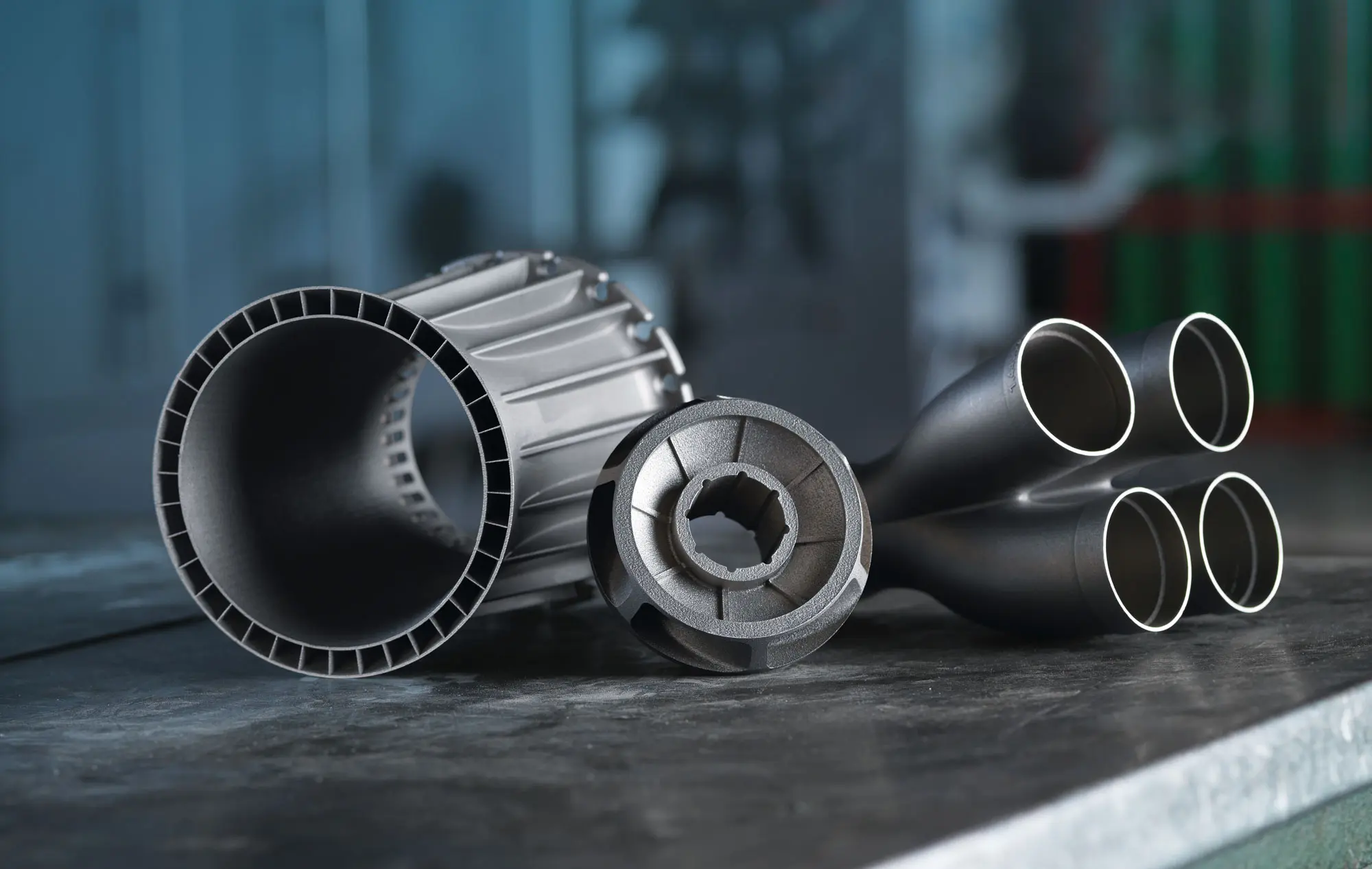
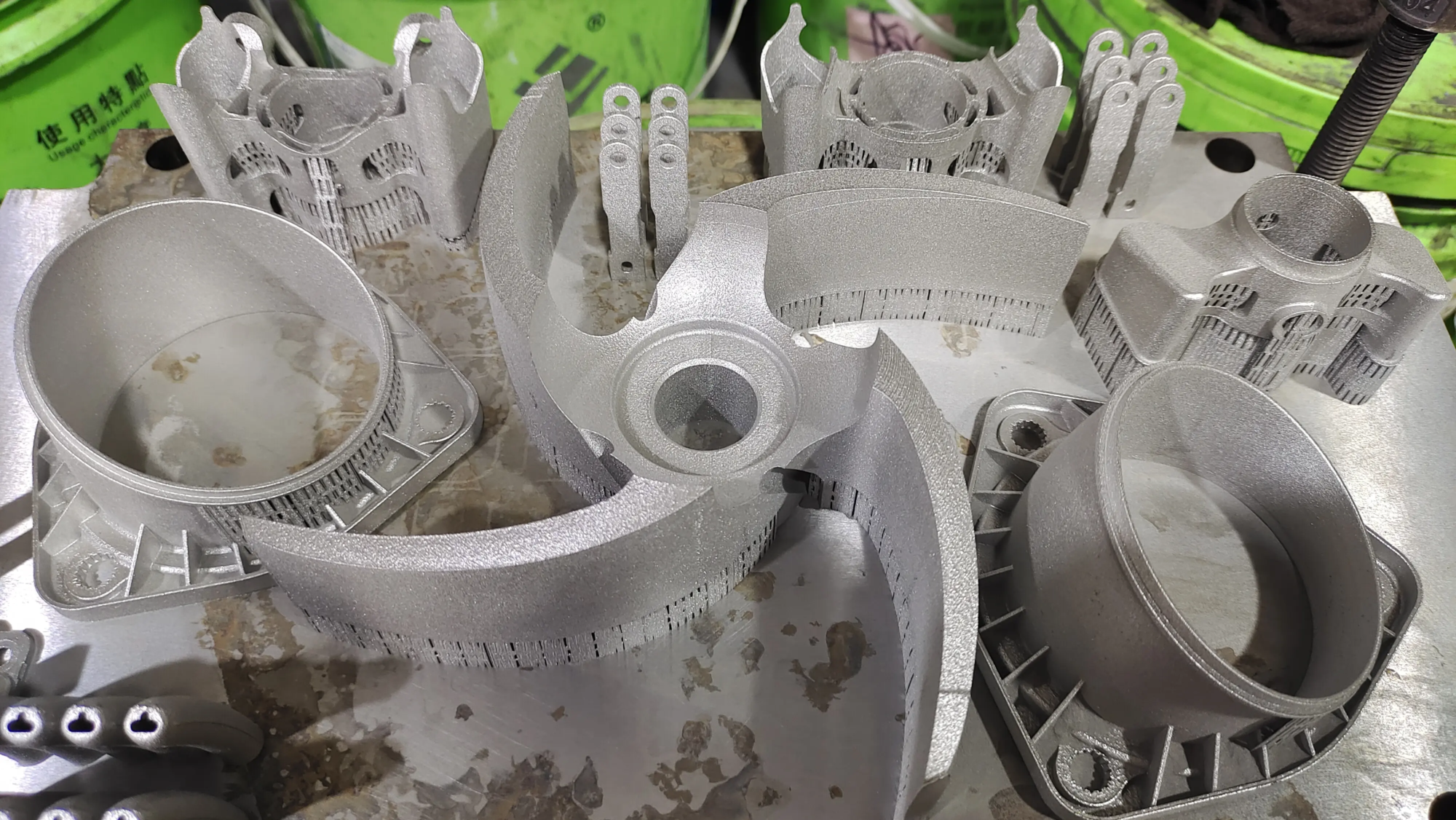
- Metals dominate: That’s where technology like this comes in Selective Laser Melting (SLM) shine. High-strength aluminum alloys such as AlSi10Mg or AlSi7Mg0.6 are the primary materials for chassis panels, brackets and potentially gearboxes. Titanium (Ti6Al4V) provides an unparalleled strength-to-weight ratio for weapons, shafts and critical pivots. Advanced steels and alloys such as Inconel are found in high temperature or extreme impact applications. SLM carefully fuses fine metal powders into fully dense functional parts.
- Advanced Polymers (Strategic Uses): While metals dominate key structural elements, polymers play a vital role: custom mounts/insulators for electronics using high-temperature plastics such as PEEK or PEKK. Internal drive components (gears, pulleys) require wear resistance and low friction. Flexible sacrificial armor elements designed to absorb kinetic energy. Stereolithography (SLA) or selective laser sintering (SLS) often perform these roles.
SLM: The Weapon Maker’s Choice (and the GreatLight’s Strengths)
For critical structural metal components, SLM is currently the gold standard In combat robot manufacturing. Why?
- Extraordinary strength: Produce nearly or completely dense parts that match (and sometimes even exceed) the mechanical properties of conventionally manufactured parts.
- Accuracy and surface clarity: Achieve intricate details and smooth internal channels, essential for cooling and cable routing.
- Material Compatibility: Handling the highly demanding alloys (aluminium, titanium, special steels) on which combat robots depend.
Harnessing this power requires more than just a printer. It requires deep expertise:
- Design for Additive Manufacturing (DfAM): Merely using CAD is not enough. part must Designed for additive manufacturing – optimize strength direction/minimize supports, manage thermal stress (warpage), and exploit topology. Misuse can lead to catastrophic failure.
- Mastery of process parameters: Each metal powder and required geometry determine the precise laser power, scan speed, fill pattern and layer thickness parameters. Solving this problem consistently requires a deep understanding of metallurgy.
- Post-processing capabilities: Printing metal parts often requires careful heat treatment (stress relief, solution annealing, aging), support structure removal, CNC machining of critical interfaces, and surface finishing. Skipping steps can affect your results.
Competitive Advantage: Why Builders Are Adopting Additive Manufacturing
Weaponized robots "Deep six," ORBY Blades’ blades, as well as countless other blades in the league, feature significant 3D printed components. The competitive advantage is undeniable:
- Faster design-optimize-test cycle: Shortened prototyping driven by additive manufacturing allows teams to respond to failures quickly, turning weaknesses into strengths within days.
- Ingredient specificity: Create uniquely shaped components to exploit your opponent’s weaknesses or maximize the reliability of your armor’s protective profile. There is no ready compromise.
- Enhanced weapon design: Maximize destructive potential by providing kinetic energy weapons (drum/rod spinners) with complex geometries that cannot be forged or machined by traditional methods.
- Reduce weight: Freeing up critical weight budget for heavier armor, more powerful engines, larger batteries or redundant systems.
- Elasticity: Integrated design and optimized materials reduce failure points under severe impacts.
GreatLight: Project wins at every turn
For a team pushing the boundaries of combat robotics technology, turning revolutionary designs into functional, combat-ready metal parts requires a partnership built on speed, precision and deep additive manufacturing expertise. huge light Uniquely equipped for this mission:
- Cutting-edge SLM arsenal: We utilize advanced selective laser melting technology, precisely calibrated to handle the demanding alloys combat robots rely on – from strong titanium and aluminum to high-strength steel.
- Prototyping speed: Our rapid workflow ensures quick turnaround of complex prototypes and final parts. Iterating quickly through testing is the key to victory, and we deliver that.
- Customization and expertise: Solutions tailored to your unique design challenges and material requirements. Our engineers guide DfAM best practices to optimize your model’s performance and printability.
- Post-integration processing: Beyond printing: comprehensive heat treatment, precision CNC machining of critical fits and surfaces, meticulous polishing and finishing. All under one roof, quality and consistency are guaranteed.
- Innovative problem solver: We embrace the inherent complexity of cutting-edge combat robots. If your design pushes the boundaries, we’ll work together to find a manufacturability solution.
- Material flexibility: Can accommodate almost any metal material needed for a combat robot and customize it to specifications.
Ready to weaponize your designs?
The arena awaits the next generation of champions built through additive manufacturing innovation. Let GreatLight be your rapid prototyping partner to transform your boldest robotic visions into physics-led combat reality. Customize your precision metal rapid prototyping parts with us – optimized for performance, delivered at a competitive value.
Conclusion: Beyond Arena Sparks
Integrating 3D printing into the BattleBot project is not only a technical highlight, but also an innovation. This was a fundamental shift that accelerated the development of robot combat. It enables builders to transcend the limitations of old methods and unlock unprecedented levels of customization, structural optimization, and rapid iteration. From complex titanium weapons to resilient alloy chassis, additive manufacturing offers components that would have been unattainable just a decade ago. This technology simultaneously intensifies fierce competition while driving the development of materials science, lightweight design strategies, and rapid prototyping methods that reach well beyond the battlefield into aerospace, automotive, and industrial applications. As printers become faster, materials more advanced, and expertise broader, combat robots that showcase the pinnacle of additive manufacturing engineering will continue to captivate audiences and redefine robotic capabilities.
FAQ: BattleBots and 3D Printing Demystified
Question 1: Can 3D printed parts actually survive a BattleBot battle?
Absolutely! Carefully designed and correctly printed metal parts (especially high-strength alloys such as titanium 6Al-4V or AlSi10Mg aluminum processed by SLM) exhibit excellent elasticity. The key factors are the optimization of impact direction and load geometry by experts DfAM, the correct selection of metal powders and careful post-processing (heat treatment, machining). Failures often stem from improper application rather than the inherent capabilities of additive manufacturing.
Question 2: Is metal 3D printing (such as SLM) too expensive for robotics enthusiasts?
While historically expensive, costs are falling due to more readily available hardware and services. Companies like GreatLight specialize in providing rapid prototyping solutions at competitive prices, making professional-grade SLM production easy. Set up a co-op or utilize printed parts criticalCompared to ultra-high-end CNC, highly optimized components such as weapons systems or structural wheels are very feasible even for smaller teams where the performance gains outweigh the cost.