

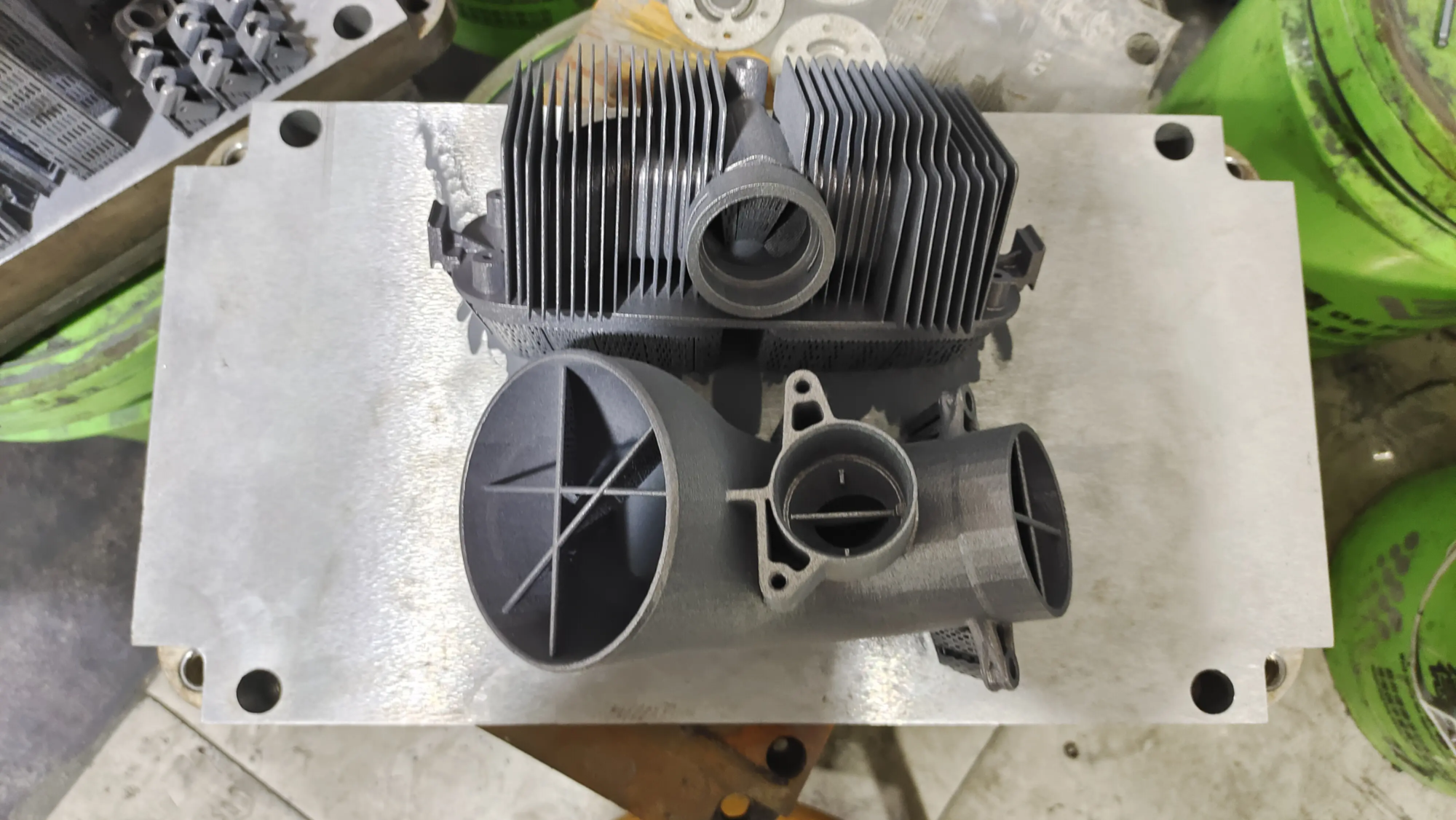
Unlocking Rapid Manufacturing: How Binder Jetting Speeds Product Development
Manufacturing technology continues to evolve in the relentless pursuit of faster innovation cycles and more cost-effective production. in, Binder Jetting (BJT) Stand out as a basic technology rapid prototypingbridging the gap between digital design and tangible reality with unprecedented speed and versatility. At GreatLight, leveraging advanced BJTs along with our SLM capabilities allows us to provide our customers with the ultimate agile manufacturing solution.
Beyond the Layer: Binder Jetting Process Explained
Unlike processes that use lasers or extruders to fuse powdered materials point by point, binder jetting uses a fundamentally different yet elegant and efficient approach:
- Powder bed deposition: A thin layer of fine metal, sand or ceramic powder is precisely distributed over the build platform.
- Inkjet binding: Printhead, similar to an inkjet printer but deposits a liquid adhesive ("Binder") selectively spray droplets onto the powder along that layer cross-section of the CAD model.
- Binding and layer stacking: The binder holds the powder particles together only at the point of deposition. The build platform is lowered, a new layer of powder is applied, and the bonding process is repeated, building the part layer by layer.
- Green state extraction: After printing, the part is still encased in unmelted powder. Removing these powders reveals a loose bond "green part."
- Post-processing (critical stage): green part must Post-processed for ultimate integrity and performance. This usually involves:
- Skim: Removes most of the binder material (usually using solvents, thermal decomposition, or catalytic methods).
- sintering: Heating parts in a controlled furnace environment. During the sintering process, metal, sand or ceramic particles spread and fuse together ("neck" form), dense parts and shrink significantly (predictably). Metal parts can be infiltrated (for example, using bronze) to minimize shrinkage and further increase density.
- finishing: Like many additively manufactured parts, BJT parts often undergo secondary finishing (e.g., machining, polishing, coating) through Ferrite’s one-stop service to achieve final tolerances, surface quality, or specific mechanical property requirements.
Why adhesive jetting is great for rapid prototyping
The BJT process offers several compelling advantages specifically targeted at accelerated prototyping and low-volume production:
- Lightning speed: By spraying adhesive across the entire layer simultaneously, rather than tracing contours with a laser, BJT can make parts significantly faster than selective laser melting (SLM/DMLS) or metal FDM, especially for complex geometries or volume production. Box-level packaging maximizes throughput.
- Cost effectiveness (especially metals):
- Equipment operating costs are lower compared to high-power laser systems.
- Minimal energy consumption during printing.
- Unbound powder can often be reused (if managed correctly), thus reducing material waste. This makes functional metal prototypes more economical.
- Unparalleled design flexibility and sophistication: BJTs have few geometric constraints. Internal channels, undercuts, grids and other complex features that cannot be machined or sintered are easily achieved without supports. This enables designers to verify real, complex geometries early on.
- Scalable series production: BJT excels at producing multiple parts simultaneously within a single build volume ("Batch build"), making it ideal for pilot production, custom tooling or bridge fabrication.
- Material Versatility: BJT accommodates a variety of materials critical to prototyping:
- Metal: Stainless steel (316L, 17-4PH), tool steel, nickel alloy, titanium (existing technology), copper-infiltrated steel (commonly used).
- sand: Mainly used for casting cores and molds – revolutionizing casting patterns.
- ceramics: For special applications requiring high temperature stability or biocompatibility.
- Large format potential: BJT systems typically have higher build volumes (compared to comparably cost SLM machines), allowing for larger prototypes or more parts per run.
More than just prototypes: diverse applications
The benefits of Binder Jetting go beyond the initial concept model:
- Functional prototyping: Rigorous testing using functional metal parts (e.g. housings, brackets, manifolds).
- Bridge production: Perform short-run manufacturing while developing tools or validating market requirements.
- Custom/Jigs and Fixture Tools: Rapidly produce custom assembly aids, tool holders and fixtures.
- Casting Sand Cores and Molds: Directly print complex conformal molds/castings from traditional metal casting.
- Custom components: Low-volume, highly customized parts (medical devices, aerospace).
- Architectural models and art: Detailed large-scale models in sand or ceramic materials.
GreatLight: Your BJT strategic partner
At GreatLight, we consider Binder Jetting to be the cornerstone of modern rapid prototyping strategies. Our commitments include:
- Advanced BJT features: Utilize industrial-grade BJT systems optimized for metal and sand applications.
- Supplement SLM expertise: Combined with our advanced SLM printers, we offer correct solution your Specific metal prototyping needs – whether it’s ultra-fast BJT prototyping/custom fixtures or ultra-dense, high-strength SLM prototyping.
- End-to-end expertise: In-depth understanding and execution of critical post-processing stages – debinding, sintering, infiltration (especially metals). This is where the part properties are finalized.
- One-stop post-processing: Streamline your workflow with comprehensive finishing services – CNC machining modifications, heat treatment, surface preparation (polishing, plating, coating), inspection and assembly.
- Material flexibility: Provide customization and rapid processing of a variety of BJT materials.
- Speed and precise focus: Leverage BJ to provide fast turnaround times without compromising critical functionality


