Invisible power: Unparalleled safety with 3D printed carabiners
Carabiners are the unsung heroes of rock climbing, industrial safety and outdoor gear. This humble metal ring is the key link between life and risk. Traditionally forged or machined, these components face enormous stresses that require exceptional strength, ductility and flawless execution. But what happens when we take advantage of the design freedom and ability to iterate quickly with 3D printing? If designed correctly, a 3D printed carabiner is more than just a prototype; They represent the future of custom, high-performance security equipment. The key is understanding the intricate relationship between innovative design, advanced manufacturing, meticulous materials science, and rigorous validation—especially when lives are at stake.
Beyond the Limits: Designing for Extreme Loads
Simply using a consumer-grade FDM printer to replicate the typical carabiner shape will not produce climbing-grade gear. The strength of a 3D printed carabiner depends on strategic design choices honed by additive manufacturing (AM) and the specific loads it encounters:
-
Geometry optimization: Additive manufacturing allows organic shapes to distribute stress more evenly than machined shapes. Engineers focus on:
- Smooth transition: Eliminates stress concentration sharp corners and internal notches. Intricate internal ribbing or mesh structures reinforce key areas without adding too much bulk.
- Door mechanism integrity: Design gate interface (nose shape, gate arm profile) for consistent engagement and minimal wear, analyze hinge pin loads and gate spring forces.
- Forced door lock: Complex locking mechanisms (spiral doors, twist locks, automatic locks) are critical for life-critical applications and require complex geometries that can be effectively realized and optimized through additive manufacturing.
- Anisotropic consciousness: Unlike isotropic forged metals, AM parts exhibit directional strength based on the direction of printing. The design must take this into account, optimally placing critical load paths relative to the build direction.
-
Material Selection: Pillars of Performance: Not all filaments or metal powders are created equal. For functionality, Strong Carabiner:
- Metal is mandatory: Forget about plastics used in safety-critical applications. Industrial-grade metals have the required tensile strength, ductility (critical to avoid catastrophic brittle failure), and durability.
- Top Contenders:
- 17-4 PH stainless steel: It has an excellent strength-to-weight ratio, good corrosion resistance, and can be heat treated to achieve hardness exceeding many conventional steels (~1100-1300 MPa UTS). Ideal for parts requiring high yield strength and moderate corrosion resistance.
- Titanium alloy (Ti6Al4V): The gold standard in aerospace and demanding engineering. Unparalleled strength to weight ratio (much lighter than steel with similar UTS ~900-1100 MPa), impressive fatigue performance, and excellent biocompatibility/corrosion resistance. A must-have in ultra-light hiking gear.
- Maraging steel: Ultimate, uncompromising strength is critical (typically in excess of 1800 MPa UTS after heat treatment). For use in niche aerospace or defense applications requiring extremely high toughness.
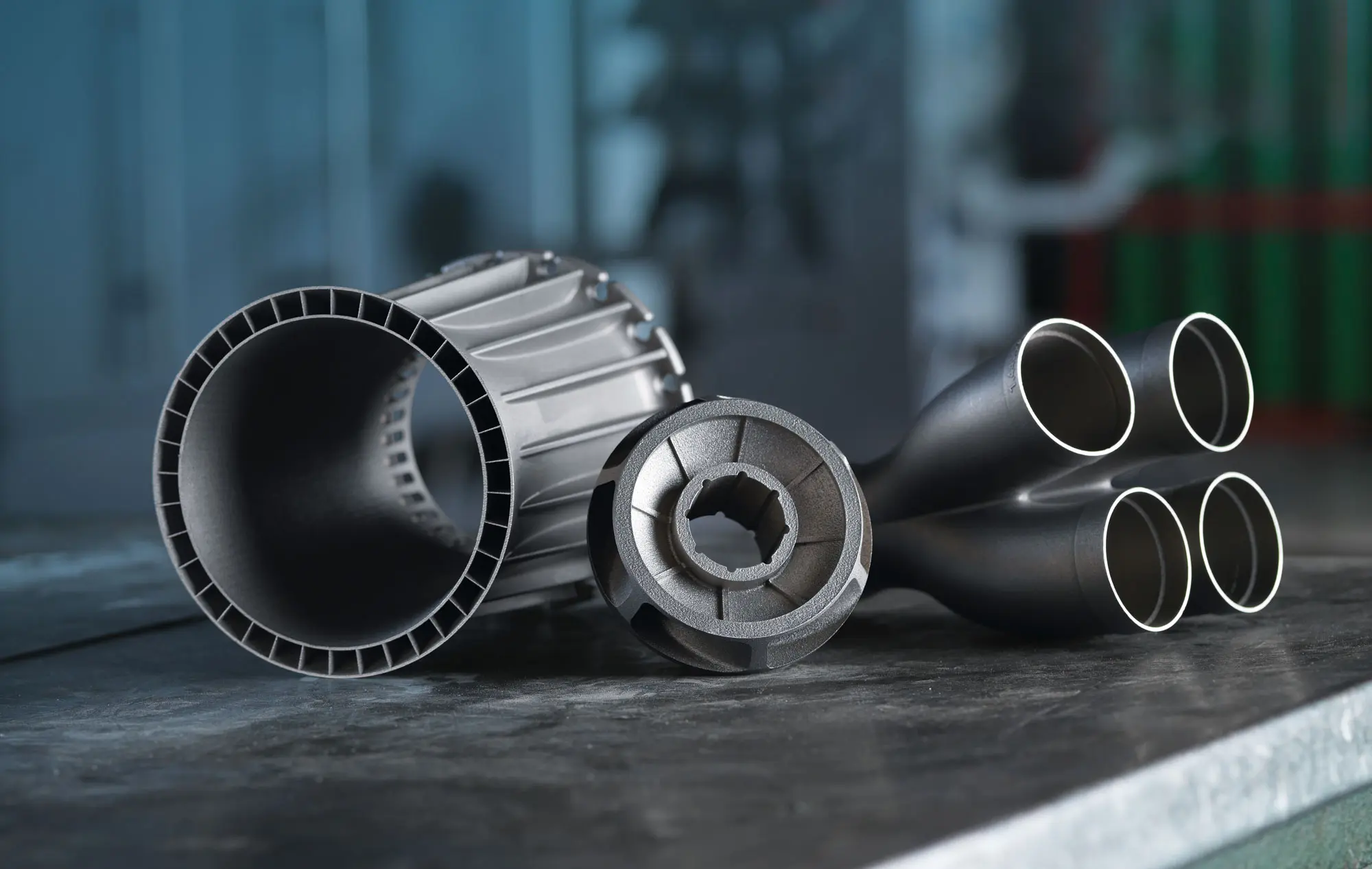
- Guoguang advantages: Working with these challenging alloys—especially reactive metals like titanium—requires specialized knowledge. huge light Leveraging deep metallurgical knowledge, it precisely controls the parameters of these materials in its advanced SLM printers, ensuring optimal melting, minimizing internal defects such as porosity, and customizing heat treatments to achieve material properties equal to or better than those in the forged form.
-
The Imperative for Advanced Additive Manufacturing Technologies: SLM: Producing dense, reliable metal carabiners requires industrial-grade selective laser melting (SLM):
- How SLM works: High-power lasers selectively melt ultra-fine metal powders layer by layer to build complex geometries with exceptional precision and near-full-density digital models.
- Why it’s important: SLM produces parts with an intrinsically uniform microstructure, which is critical for strength and fatigue life. Unlike processes such as binder jetting, SLM completely melts the metal, minimizing post-processing porosity and creating a true metallurgical bond.
- The edge of the great light: Utilizing state-of-the-art SLM equipment calibrated for aerospace-grade accuracy and repeatability, ensuring the dimensional fidelity and material consistency critical to safety-critical carabiner production.
-
Post-processing: Strength combined with safety and durability: No SLM parts can be loaded directly out of the printer. Complex post-processing changes "green" Parts become solid components:
- Stress Relieving and Annealing: Reduce the internal stress caused by the inherent rapid solidification of SLM.
- Solid solution aging/precipitation hardening (e.g., 17-4PH, maraging): Precision heat treatment cycles unlock the alloy’s ultimate strength and ductility. huge light Excels at precisely controlling these time-temperature curves.
- Critical HIP (Hot Isostatic Pressing): HIP is often indispensable for life-critical load-bearing components such as climbing carabiners. The high temperatures and pressures of applied isostatic pressing eliminate any remaining microscopic pores, significantly improving tensile, fatigue and impact properties.
- Surface treatment: Smooth surface fights where fatigue starts. Techniques include machining (gate mating surfaces!), internal channel abrasive flow machining (AFM), tumbling, polishing and custom surface treatments (such as electropolishing for corrosion resistance).
- Verify: Trust but verify: Rigorous, quantifiable testing is non-negotiable:
- Non-destructive testing (NDT): X-ray CT scans provide unparalleled internal inspection capabilities, detecting voids, cracks or inclusions invisible to the naked eye.
- Destructive testing: Representative samples are tested for tensile, elongation, impact (Charpy/Izod) and hardness to confirm material properties comply with the wrought alloy’s specification sheet.
- Functional testing: Simulates field use—gate actuation cycles, cyclic loading/unloading, gate closing/releasing forces—ensuring reliability under repeated strains.
- Certification: Alignment with stringent international standards (eg, UIAA 121 for mountaineering equipment, EN 362 for PPE connectors) is critical for commercial deployment. glorious Expertise also includes advising on testing scenarios and providing supporting documentation.
Conclusion: A strong future for printing
3D printed carabiners won’t replace mass-produced hooks overnight. This is about unlocking a future in which safety-critical connectors are lighter, more efficient, perfectly tailored for niche applications, or rapidly prototyped for rigorous engineering validation far faster than traditional methods allow. Success depends on a deep understanding of design principles for additive manufacturing, mastery of high-performance metals such as titanium and steel alloys through advanced SLM technology, and a strong commitment to post-processing accuracy and exhaustive validation testing.
This holistic approach, which integrates cutting-edge design optimization, precision SLM manufacturing, expert materials handling and rigorous aerospace-grade finishing, is key to achieving this goal. huge light Sparkling. As a leader in rapid prototyping and low-volume production using advanced SLM technology, huge light Have the expertise and infrastructure to expertly solve complex metal prototyping challenges. Whether you are designing the next generation of lightweight climbing gear, specialized industrial connectors or critical defense hardware, their ability to quickly customize for most materials, coupled with comprehensive one-stop post-processing and finishing services, makes them a valued partner. Correctly engineered and manufactured to the highest standards, 3D printed carabiners represent not only innovation but a tangible leap forward in achievable strength and custom safety solutions. Ready to bring your most powerful designs to life? [Explore custom precision prototyping solutions today.] (Make this link clickable to your service page).
FAQ: Uncovering the Secrets of 3D Printed Carabiners
Question 1: Are 3D printed carabiners actually strong enough for climbing or safe use?
Answer: Yes, if Designed correctly. Consumer plastic printers are irrelevant here. Metal 3D printing using SLM/SLS and aerospace-grade alloys such as titanium (Ti6Al4V) or maraging steel/17-4PH steel, followed by rigorous HIPping, heat treatment, and thorough testing to UIAA/EN standards, can produce carabiners that meet or exceed the strength requirements of their forged counterparts. design must Optimized for AM.
Q2: What is the strongest metal for 3D printed carabiners?
Answer: There is no single "The strongest." It depends on the design and requirements:
- Ultimate tensile strength: Maraging steel can exceed 1800+ MPa after heat treatment.
- Strength to weight ratio: Titanium (Ti6Al4V) dominates.
- Corrosion resistance and cost-effectiveness: 17-4 PH stainless steel offers excellent balance. Material selection must consider the entire loading scenario and environment.
Q3: Why is SLM particularly important for carabiners?
A: SLM uses a laser to completely melt metal powder, creating a nearly completely dense part with excellent metallurgical bonding. This high density and uniformity is critical to achieving the isotropic structural integrity and fatigue life required for safety-critical components such as carabiners. FDM and other processes