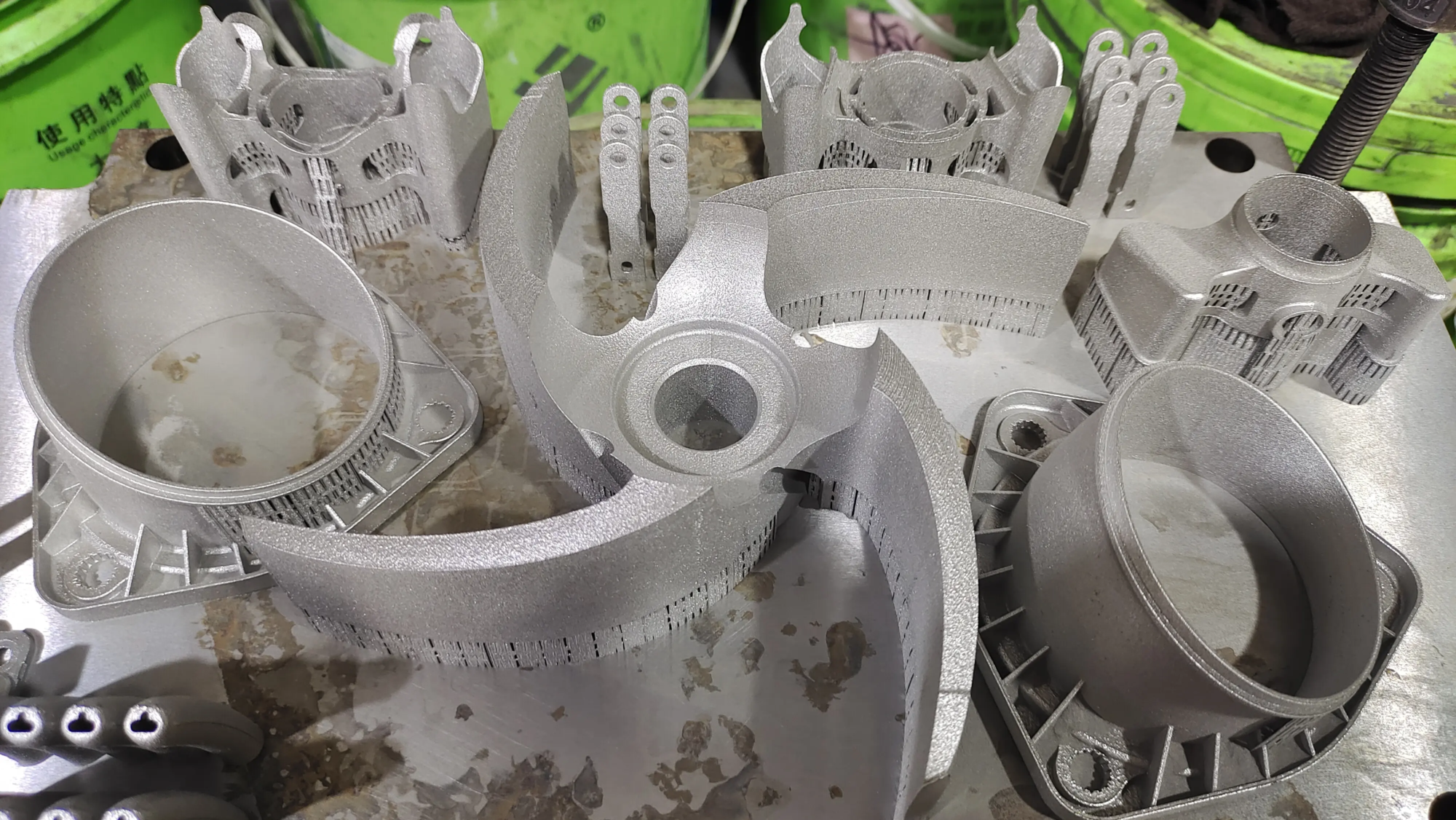
Cutting Edge: Innovations in 3D Printed Cone Reshape Manufacturing
cone. At first glance, seemingly simple geometric shapes are the basic building blocks of engineering teaching aids, fluid dynamics components, acoustic devices or structural supports. However, producing them precisely, especially for demanding industrial applications, often exposes the limitations of traditional manufacturing. Subtle curvatures, complex internal features, stringent material requirements, or complex lattice structures may change "simple" Trapped in a nightmare of creation. This is where additive manufacturing (AM), commonly known as 3D printing, comes in, not just as an alternative but as a catalyst for transformative innovation, breathing new life into tapered parts.
For pioneers like GreatLight, which specializes in rapid prototyping and production through technologies like Selective Laser Melting (SLM), these innovations bring exciting possibilities. We see every day how 3D printed cones transcend basic geometries to become highly engineered solutions that unlock unprecedented performance.
Beyond basic geometry: the engine of innovation
The real power of additive manufacturing lies in the design freedom not possible with subtractive methods. For cones, this manifests itself in several groundbreaking ways:
- Radical Materials Science: Traditional cones are often limited by the choice of materials suitable for machining or forming. Metal 3D printing, specifically the SLM used by GreatLight, enables aerospace-grade titanium alloys, nickel superalloys, reactive aluminum alloys and specialty stainless steels. Cones can now operate in extreme environments – jet engine combustion chambers requiring Inconel, lightweight satellite components made of Scalmalloy®, or medical implants that benefit from biocompatible cobalt-chromium alloys. Each material choice allows the cones to perform functions that were previously impossible.
- Comprehensive complexity and functional gradient: Imagine a tapered fluid nozzle with integral swirl vanes optimized using CFD analysis, or a sound cone with a density gradient precisely tuned to absorb sound at different frequencies. 3D printing builds these features into cones period manufacture. Multi-material printing paves the way for cones with different structural properties—a wear-resistant tip that seamlessly transitions to a shock-absorbing base.
- Intelligent topology optimization: Why waste materials? Generative design algorithms allow us to create extremely strong and stiff cones only where needed. By optimizing the internal lattice and external surfaces based on simulated loads, we produce ultra-light tapered structures that mimic bone, significantly reducing the weight of aerospace drone components or high-performance automotive components while maintaining or enhancing mechanical integrity.
- Conformal cooling channel: In injection molds, cooling time dominates the cycle. 3D printing can create tapered cores or mold inserts with complex curved cooling channels that closely follow the contours of the cone. This revolutionary design greatly improves cooling efficiency, shortens cycle times, minimizes warpage, and improves part quality of molded components – a significant competitive advantage for tool manufacturers.
- Monolithic integration: Why assemble multiple parts? 3D printing enables cones to be manufactured as a single unified component, integrating mounting flanges, internal piping, threaded interfaces or optical pathways. This eliminates assembly steps, reduces potential failure points (such as welds or bolts), improves performance consistency, and simplifies the supply chain.
Tangible advantages that change an industry
The above innovations translate into compelling real-world benefits in different fields:
- Lightweight Champion: Topology-optimized metal cones in aerospace reduce fuel consumption and increase payload capacity. Lightweight polymer cones enhance ergonomics for wearable technology or robotics.
- Performance enhancements: Enhance fluid flow in nozzles (rockets, fuel systems), improve heat dissipation in thermal management cones, optimize sound control capabilities in sound baffles.
- Rapid prototyping and design iteration: GreatLight leverages the speed of additive manufacturing to enable engineers to quickly design, 3D print and test large numbers of cone-shaped prototypes (cones with integrated sensors one week, geometry-altered versions the next), significantly accelerating innovation cycles compared to traditional tooling lead times.
- Customization like never before: From personalized ergonomic grips to patient-specific implants that mimic anatomical shapes, unique cones are becoming feasible and economical even in small batches.
- Supply chain resilience and on-demand production: Eliminating complex tooling enables decentralized production. Critical replacement cones, even on obsolete equipment, can be reverse engineered and printed quickly.
Industry Applications: Combining Innovation and Impact
3D printed cones find advanced applications in:
- Aerospace and Defense: Engine components (nozzles, diffuser cones), lightweight structural supports, radomes, satellite thruster cones.
- Automotive/Motorsport: Lightweight suspension links, optimized air intake cone, aerodynamic components, conformal cooling injection molded core.
- Medical devices: Customizable femoral heads, spinal implant components, hydrodynamic dental tools, inhaler vaporization chambers.
- Industrial equipment: High flow valves, cyclones, specialized sensor housings, high efficiency heat exchanger manifolds.
- consumer goods: High-fidelity speaker diaphragms, ergonomic electrical components, complex extruder molds for custom filament or food products.
Use expertise to meet challenges: Guoguang Advantages
While revolutionary, challenges remain:
- Surface finish: Metal AM parts often exhibit inherent roughness. GreatLight excels here, offering a comprehensive suite One-stop post-processing solution – Precision CNC machining to meet tight tolerances on critical surfaces, tumbling to smooth large geometries, sandblasting or vibration polishing to enhance aesthetics, heat treatments to optimize material properties, and special coatings to enhance durability or biocompatibility. Our expertise ensures that the finished cone meets functional and cosmetic requirements.
- Material consistency and complexity: High-performance alloys require precise processing parameters. Our advanced SLM printer Operates under strict environmental controls and utilizes carefully validated process parameters to ensure metallurgical integrity and repeatability of complex tapered geometries.
- Design for Additive Manufacturing (DfAM): Maximizing the potential of additively manufactured cones requires specialized design thinking. our In-depth cooperation between engineering teams Work with customers to apply DfAM principles—optimizing support structures, minimizing thermal stresses, and appropriately utilizing the lattice—to transform design challenges into optimized printable solutions.
- Validation and quality: We prioritize rigorous metrology. Utilizing coordinate measuring machines and advanced scanning technology, we carefully verify dimensional accuracy, geometric consistency and surface quality to ensure the final tapered part meets design intent.
Why work with Gretel?
At GreatLight, we are more than just a supplier; we become your innovation partner in additive manufacturing. We specialize in solving the complex challenges inherent in precision metal prototyping and production.
- Dedicated Metal Prototyping Expertise: and Advanced SLM technologywe specialize in solving complex rapid prototyping problems.
- Unparalleled one-stop service: From initial DfAM consultation, to printing on industrial grade SLM systems, to our extensive Precision machining capabilities (machining, polishing, heat treatment, surface treatment), we manage the entire process under one roof. Simplify your supply chain.
- Material Versatility: We offer a wide range of material options and capabilities Quick processing and customizationcustomized solutions based on your functional needs.
- Focus on precision: Customized precision machining are an integral part of our service, ensuring that key features of complex cones meet exacting standards.
- Speed and value: identified as One of the best rapid prototyping companies in Chinawe deliver Customize precision rapid prototyping parts at competitive pricesspeeding up your time to market.
In an age of sophistication, customization and performance innovation, the humble cone has undergone a high-tech metamorphosis. Modern 3D printing unlocks geometries and capabilities that were once considered impractical. From optimizing jet engines to enabling personalized medical devices, tapered components are delivering tangible benefits. Taking advantage of these innovations requires technical expertise and advanced capabilities – and that’s exactly what GreatLight delivers. Our proven ability to navigate material complexity, deliver superior surface finishes, and deliver total engineered solutions ensures your tapered parts transition seamlessly from innovative concept to high-performance reality.
in conclusion
The innovations changing the world of 3D printed cones highlight a key shift: Additive manufacturing goes far beyond prototyping simple shapes. Today, it enables engineers to fundamentally rethink tapered parts—optimizing their mass, embedding complex functionality, and making them from materials that were previously unsuitable. These breakthroughs deliver significant benefits: unparalleled lightweighting, enhanced performance characteristics, accelerated design iterations, easy customization, and streamlined supply chains. While challenges such as surface finish optimization require complex post-processing expertise, partners like GreatLight can effectively solve these problems. We unlock the full potential of these innovations by leveraging advanced SLM printing and comprehensive finishing services. Whether enabling groundbreaking aerospace propulsion or customized medical treatments, modern 3D printed cones are a prime example of how additive manufacturing is reshaping what is possible in engineering, pushing the boundaries of what was considered possible with traditional methods.
FAQ: Uncovering the Secrets of 3D Printed Cone Innovation
-
Q: Why use 3D printed cones instead of machining?
one: Conventional machining faces challenges with cones requiring complex internal features such as integrated lattices or curved channels, complex surface geometries, extreme lightweighting through topology optimization, or single material gradients. 3D printing builds these complexities directly, offers superior design freedom, minimizes material waste, and excels at producing prototypes or low-volume custom parts where tooling is expensive. -
Q: What materials are commonly used for 3D printing metal cones?
one: The choice depends largely on the application:- Aerospace/High Temperature: Titanium alloy (Ti6Al4V), nickel-based high-temperature alloy (Inconel 625, 718), aluminum alloy (Scalmalloy®, heat-treatable varieties).
- Medical: Biocompatible titanium alloy (Ti6Al4V ELI), cobalt-chromium alloy.
- Industrial/General: Stainless steel (316L, 17-4PH), maraging steel (tools).
GreatLight provides recommendations for optimal material selection based on functional requirements.
-
Q: Can 3D printed metal cones achieve a smooth surface?
one: Printed metal parts exhibit surface roughness. Achieving smooth surfaces requires experts Post-processing. GreatLight uses techniques such as precision surface CNC machining, micro-finishing electropolishing, sand blasting, vibration finishing or tumble grinding, which are then inspected to meet strict surface quality specifications. -
Q: Are 3D printed cones strong enough for structural applications?
one: Yes, absolutely. When printed using an optimized SLM process and rigorously validated parameters (as practiced by GreatLight), metal cones can often achieve mechanical properties that are equal to or better than those of conventional forged parts. Topology optimization allows designers to strategically place materials where strength is needed, creating parts that are both lightweight and lightweight and Strong. Post-treatment heat treatment further enhances the material’s strength properties. -
Q: How much does it cost to make or produce a custom 3D printed cone?
one: Cost is affected by factors such as cone size/complexity, material selection, required build volume, tolerances, surface finish requirements, quantity and required post-processing. While prototyping avoids the tooling costs inherent in casting/machining, the complexity does impact print time/material usage. Gretel focuses on providing fast Customize at the best price Without affecting quality—— Request a quote Provide the most accurate cost estimate for your specific design. Our expertise ensures the value of optimized solutions. -
Q: Which industries benefit most from these innovations?
one: Industries driving innovation include:- Aerospace and Defense: Reduce weight for complex geometries for propulsion/flow control.
- Medical: Patient-specific implants, biocompatible materials.
- Cars/Racing: Customized lightweight, high-performance components.
- Industrial machinery: Optimized fluid system, special tools (conformal cooling).
- vitality: Flow control elements, heat exchangers.
- consumer goods: Custom audio equipment (tweeters), ergonomically designed.
- Q: How fast can the GreatLight turn prototype tapered parts?
one: loyal to us rapid prototyping Core competencies that often deliver initial prototypes of complex cones