The Rise of PTFE 3D Printing: Unlocking New Possibilities for High-Performance Manufacturing
For decades, polytetrafluoroethylene (PTFE) (best known as Teflon®) has been a cornerstone material in demanding industrial applications. Its legendary chemical resistance, exceptional non-stick properties, excellent electrical insulation and ability to withstand extreme temperatures (-200°C to 260°C) make it irreplaceable. However, manufacturing complex PTFE components has traditionally involved complex and wasteful processes such as compression molding, sintering and extensive machining. These methods severely limit design freedom, make it difficult to resolve internal geometries, and result in significant material loss. Enter Additive Manufacturing (AM): PTFE 3D printing is overcoming these traditional limitations and unleashing a wave of innovation.
Why PTFE poses unique 3D printing challenges
PTFE is not a typical thermoplastic. Its innate characteristics make 3D printing notoriously difficult:
- Ultimate melt viscosity: Near its melting point (approximately 327°C), PTFE transforms into a highly viscous gel rather than a free-flowing liquid, making extrusion printing extremely challenging.
- Infusibility: Pure PTFE molecules do not stick to each other or to adjacent layers as easily as traditional plastics under heat and pressure, resulting in weak inter-layer adhesion and poor inter-layer adhesion.
- Sensitive degradation: PTFE begins to degrade slightly above its melting point (approximately 380°C), releasing potentially dangerous fumes. Maintaining a narrow, precise temperature window is critical for safety and part integrity.
- Significant sintering shrinkage: Printed PTFE "green parts" Meticulous high-temperature sintering is required (often in excess of 360°C), resulting in substantial anisotropic shrinkage that must be carefully compensated for in the design.
Breakthrough innovation revolutionizes PTFE printing
Driven by advances in materials science and hardware, significant progress has been made in overcoming these obstacles over the past few years:
-
Advanced PTFE Composite Materials and Blends: The key breakthrough was not to print pure PTFE, but to cleverly modify it. The development of professional formulas is crucial:
- Proprietary PTFE/PEEK blend: Combining PTFE powder with PEEK enhances flow properties sufficient for extrusion while maintaining most of PTFE’s core properties (chemical resistance, low friction). Filaments such as Dyneon™ PTFE-PEEK can be used in high-temperature fused filament fabrication (FFF) printers.
- Ultra-fine PTFE powders and granules: Specialized powder formulations with precise particle size distribution and flow agents are critical to effective powder bed processing.
- Glass/Vecrus™ enhanced grades: The addition of fine glass microspheres or engineered mineral fillers such as Vecrus™ significantly reduces sintering shrinkage (to approximately 8-10% as opposed to the unfilled 15-25%) and increases dimensional stability and stiffness without significantly sacrificing chemical inertness. These filler grades are the main materials used commercially.
-
Professional printing technology: Standard printers fall short. Specialized systems have emerged:
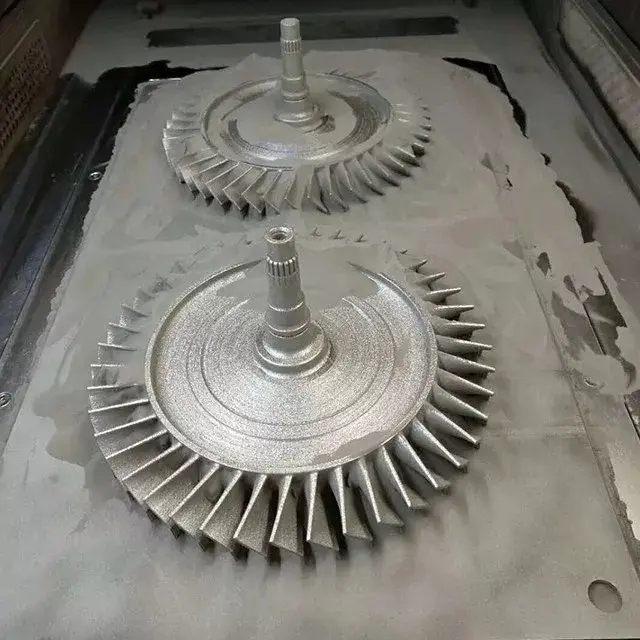
- Powder bed sintering: Reminiscent of SLS (Selective Laser Sintering), it involves depositing thin layers of PTFE composite powder and selectively bonding areas using an intense infrared laser beam. The unsintered powder supports complex geometries during the build process. Post-molding sintering in a dedicated high-temperature furnace consolidates and densifies the part. This method provides the highest resolution and geometric freedom for PTFE.
- High temperature pellet extrusion: Improved FFF printers run >400°C nozzle temperatures and are equipped with hardened nozzles and dedicated heated molding chambers capable of handling high-temperature engineering plastics such as PEEK/PEKK, and can now handle certain PTFE blended pellets. These are generally less detailed but more scalable for larger parts.
-
Sophisticated design and simulation software: Predicting and compensating for anisotropic sintering shrinkage is critical. Advanced simulation tools analyze part geometry and print orientation to generate compensated digital models. printed "green" The part is intentionally oversized; during the sintering process, it shrinks precisely (and predictably) to the final desired size through careful calibration.
-
Optimized sintering cycle: Understanding the complex sintering dynamics of PTFE/green part structures is critical. Precise control of heating rate, peak temperature, residence time and sintering atmosphere (usually an inert gas such as nitrogen to prevent degradation) determines the final density, mechanical properties and dimensional accuracy. Multi-stage sintered profiles tailored to specific part geometries and wall thicknesses maximize performance.
- Advanced post-processing: Achieving true PTFE properties often requires finishing beyond sintering:
- Precision machining: Critical sealing surfaces or interfaces may require CNC machining to achieve dimensional perfection. Because sintered PTFE is soft and easily deforms under pressure, it is critical to work with a supplier that specializes in processing sintered PTFE.
- Surface treatment: Certain applications may benefit from controlled surface etching for bonding or special coatings.
Unlock transformative applications:
These innovations open doors previously closed to PTFE:
- Complex fluid handling: Seamless, leak-free manifolds, complex valve bodies, impellers and pump assemblies built to withstand the most corrosive chemicals found in chemical processing, semiconductor manufacturing and pharmaceuticals.
- High frequency electronic devices: Seals, antenna housings, radomes, waveguides and insulating components that maintain dielectric performance under extreme temperatures and frequencies.
- Low friction and non-stick: Specially designed bearings, seals (lips, piston rings), guides and wear pads require minimal lubrication and are free of stickiness – critical in food processing, packaging and harsh environments.
- Medical devices: Biocompatible components require extremely high levels of cleanliness and resistance to chemical sterilization.
- Maintenance and spare parts: On-demand manufacturing of traditional PTFE parts for the aerospace, energy and industrial machinery sectors that are often not otherwise available.
Navigating complexity requires expertise: While PTFE 3D printing is revolutionary, successfully utilizing it requires expertise in materials, process parameters, sintering science, and compensation design. Choosing a manufacturing partner with deep expertise is critical to realizing your full potential and realizing functional, high-performance parts.
Conclusion: Materials Transformed by Additive Manufacturing
Thanks to continued innovation in materials, equipment, software and process understanding, PTFE 3D printing has evolved from a theoretical challenge to a practical manufacturing solution. The development of high-performance composite materials, specialized sintering processes, and advanced dimensional compensation techniques overcome the inherent additive manufacturing barriers of PTFE. This unlocks the potential to manufacture functional PTFE parts with complex geometries that were previously unfeasible or prohibitively expensive. From revolutionizing chemical processing equipment to enabling next-generation electronics and medical devices, PTFE AM is driving progress in critical industries. As printer technology evolves, sintering cycles become more refined and composite formulations offer greater stability, the integration of PTFE into the additive manufacturing world will only accelerate, solidifying its role as a cornerstone material for future high-performance applications. For industries that rely on PTFE, embracing these innovations is no longer optional; it is critical to enabling next-generation designs and performance ranges.
FAQ: Demystifying PTFE 3D Printing
-
Q: Is it really possible to 3D print? pure Teflon?
one: Currently, printing commercially viable pure PTFE with sufficient layer adhesion and strength remains elusive due to its extreme viscosity and bonding challenges. Successful additive manufacturing materials are almost always proprietary composites – primarily blends of PTFE with fillers such as glass microspheres or Vecrus™, or with polymers such as PEEK. These composites retain their core benefits (chemical resistance, low friction, high temperature stability) while achieving printability and dimensional stability during the sintering process. -
Q: How strong are 3D printed PTFE parts compared to traditionally manufactured PTFE?
one: Strength is highly dependent on material formulation, printing process, sintering cycle and part design. Properly printed and sintered PTFE composites can achieve mechanical properties comparable to some grades of molded PTFE. Tensile strength is typically 10-20 MPa, similar to unfilled molded PTFE. However, they typically lag behind highly filled compression molding grades designed for extremely high strength. The main advantages lie in geometric complexity and reduced lead times, but do not necessarily exceed the ultimate strength of optimally molded resin-based parts. - Q: What are the main limitations of PTFE 3D printing?
one: Major limitations include:- Material selection: Mainly limited to filled composites