Testing a 3D printed toaster: pushing the boundaries of functional prototyping
From intricate works of art to aerospace components, the possibilities for additive manufacturing often feel limitless. But can it create something as seemingly mundane but as demanding in calories as a functional kitchen toaster? We set out for a hands-on experiment using advanced Selective Laser Melting (SLM) metal 3D printing to find out: Can a 3D printed toaster actually toast bread?
Why test a toaster?
The humble toaster faces unique challenges: exposure to high temperatures (often over 200°C/400°F), electrical current, mechanical repetition (lever mechanisms) and food safety considerations. Successfully creating a product demonstrates more than just printing capabilities; it demonstrates expertise in designing for real-world thermal stresses, integrating electronics, and ensuring structural integrity under cyclic loading. It is the perfect testbed for the maturity of metal 3D printing for functional end-use consumer products.
GreatLight Prototyping Journey:
-
Design and material selection – safety first:
Our journey begins with meticulous CAD design. We prioritize:- Thermal management: The walls in the critical thermal zone (around the heating element) are thickened. Significant internal voids are designed to break thermal bridges and act as thermal breaks.
- Material: Stainless steel 316L was chosen for its excellent strength, corrosion resistance, biocompatibility (relevant for food proximity) and, most importantly, good high-temperature properties compared to polymers.
- Component strategy: While the core chassis, lever mechanism, and spring-loaded slots were designed for SLM printing, critical safety components were sourced conventionally. These include commercial heating elements (nichrome wire embedded in ceramic insulators mounted within printed channels), wires, plugs, thermostat/bimetal timer and crumb tray. Integrating these securely is a core design focus.
- Post-processing commands: We planned extensive finishing: critical surface smoothing (inside and out) to reduce areas where crumbs or moisture could hide, gentle sandblasting for an even aesthetic, and ensuring no loose metal powder remains anywhere.
-
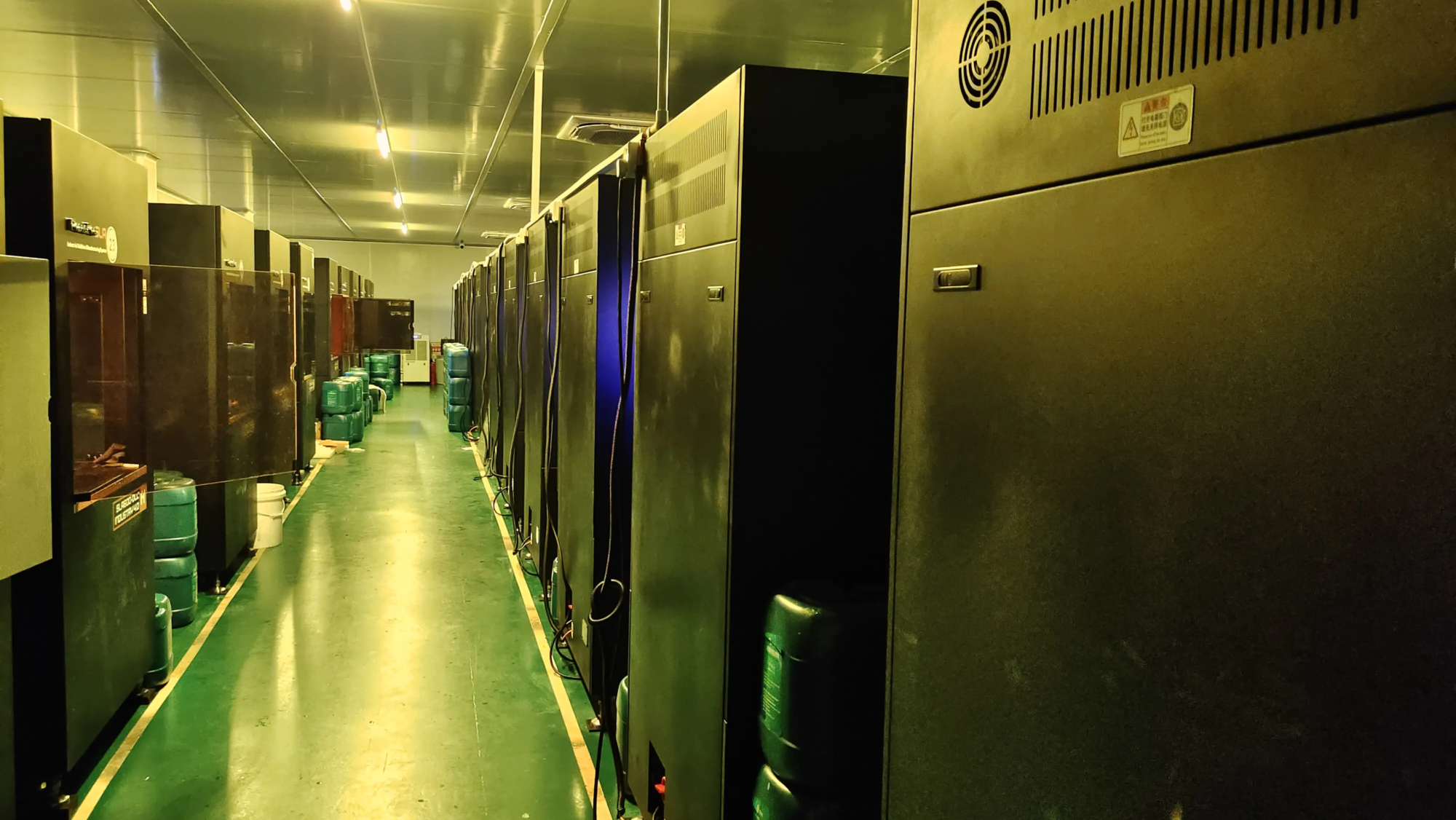
Print on SLM platform:
Use our industrial-grade SLM machines to print stainless steel components layer by layer. Main things to note during the printing process:- direction: Parts are designed to minimize support in critical functional areas that require smooth surfaces or complex geometries.
- Parameter accuracy: Laser power, scan speed and fill pattern are optimized for SS316L to achieve near full density (>99.5%), which is critical to prevent thermal distortion and ensure structural integrity. Special attention is given to internal channels for mounting heating elements and wiring.
- Support strategy: Carefully placed locations minimize residual stress and prevent warping during high-temperature printing.
- Post-processing and assembly:
This stage turns out to be crucial:- Disassembly and cleaning: Supports are carefully removed by CNC machining and EDM techniques when necessary. Parts undergo ultrasonic cleaning and a specialized powder removal process.
- Surface treatment: The heating element and the inner surface of the loaf are carefully smoothed with tool-based finishing to prevent cracking and aid cleaning. Exterior aesthetics improved by sandblasting. Further polishing options were considered but deemed less important for this prototype.
- assembly: Carefully insert a commercial heating element into its printed channel. Wiring is routed through printed conduit and connected to the timer/thermostat and power plug. Integrated non-printing mechanical parts (lever spring, crumb tray). Electrical safety inspections are critical throughout the assembly process.
Moments of truth: testing procedures
With goggles on, a fire extinguisher nearby, and a GFCI-protected outlet, we started testing:
- Initial power-up and safety checks: No bread, briefly electrified. The heating element was observed to glow red as expected. Monitor the printed structure for any unusual smells, sparks, or immediate overheating.
- Functional load testing (Toast testing): Insert standard sliced bread. Run multiple cycles at medium to high settings.
- Is it toast? Yes. Bread browns significantly and becomes crispy.
- How even? Surprisingly compared to high-end commercial units, but not entirely consistent. A slight change was observed at the edge of the slot near the printed end cap, which may be due to a slight heat sink effect due to the mass of the metal casing compared to the insulating properties of a conventional toaster casing. "One-sided" Baking is avoided.
- Circular Mechanics: When the timer starts, the lever mechanism makes the toast pop up firmly and reliably. SLM stainless steel has proven to have sufficient inherent strength.
- Overheating/deformation? Post-cycle inspection revealed localized heating of the metal chassis surrounding the component holder, but no significant deformation, warping, or degradation. The SS316L handles the thermal load brilliantly.
- Durability: Multiple cycles: Dozens of toast loops were run continuously. Monitoring the temperature buildup on the casing shows that it gets very hot (like metal), but the structure remains stable. Function showed no degradation.
Result: Successful with caveats
Our 3D printed stainless steel toaster prototype absolutely effective. It performs its primary function: reliably converting bread into toast over multiple cycles. This is a significant achievement and demonstrates the capabilities of modern metal additive manufacturing of complex thermal management components.
Main points and limitations:
- Functional feasibility has been demonstrated: SLM 3D printing, using suitable materials such as SS316L and careful heat-sensing design, can create functional appliances that can withstand huge thermal stresses.
- Material matters: Polymers are not suitable for this type of application. Metal printing, especially high-temperature alloy printing, is crucial.
- Hybrid approach wins: Combining printed structural/functional components (chassis, mechanisms) with rigorously designed off-the-shelf parts (heating elements, electronics) is a pragmatic and safer approach.
- Thermal management is complex: While succeeding, achieve Perfect Uniform baking highlights this challenge compared to affordable mass-produced plastic/metal hybrid units. Mass-produced toasters often use insulation to selectively trap heat and direct airflow in different ways.
- Post-processing is non-negotiable: For food adjacency and functional longevity, rigorous cleaning and surface preparation are mandatory, which adds cost and time.
- Cost and availability: Printing entire complex components such as a toaster using industrial metal additive manufacturing is much more expensive and time-consuming than injection molding and stamping. This emphasizes that the sweet spot right now is prototyping, not mass production.
Conclusion: Beyond Toast
This program isn’t about completely changing your breakfast habits. This is a rigorous technology demonstration designed to advance metal additive manufacturing capabilities to demonstrate functional performance under harsh conditions. It confirms:
- Advanced additive manufacturing systems such as SLM can produce structurally sound, heat-resistant metal parts suitable for complex functional applications.
- Expertise in design (CAD, thermal simulation), material science, printing parameter optimization ("Dial in" machines), and comprehensive post-processing is absolutely critical to success, especially safely integrating printed parts with conventional parts.
- GreatLight’s capabilities span the entire rapid prototyping workflow – from expert design consultation and SLM printing in metals like SS316L to precision CNC, EDM and surface finishing – enabling the creation of powerful functional prototypes that truly test the boundaries of possibility.
While your next kitchen purchase probably won’t be 3D printed metal, this experiment proves that for innovative applications that require complex geometries, high strength, and controlled heat resistance (such as specialized industrial tool housings, aerospace piping, custom medical device parts, or custom heat exchangers), metal additive manufacturing is not only possible, but powerful. We explore these frontiers every day.
Ready to push the boundaries with your next prototype? At GreatLight, we combine cutting-edge SLM technology with deep engineering expertise to solve your most challenging functional prototyping projects. Get a quote for custom metal precision parts today!
FAQ: Testing a 3D printed toaster
Q1: Is the entire toaster 3D printed?
A1: No need. The main metal chassis, lever mechanism and bread bin casing were printed using SLM stainless steel 316L. mission critical Safety Components such as heating elements (nichrome wire/ceramic), wires, plugs, thermostats/timers, springs, and crumb trays were purchased commercially. Integrating these components securely is a major focus.
Q2: Why use stainless steel 316L? Can’t plastic?
A2: Standard thermoplastics commonly used in FDM or SLS printing will significantly melt or deform at typical toaster operating temperatures (>200°C / 400°F). While some high-performance polymers exist, they lack the necessary structural integrity and thermal mass stability under repeated high thermal cycling. SS316L offers excellent strength, corrosion resistance, biocompatibility (taking into account incidental food contact) and critical high temperature performance.
Q3: Isn’t metal a poor insulator? Does this have any impact on efficiency?
A3: Yes, metal conducts heat much better than the plastic/insulation material in traditional toasters. This greatly affects efficiency. Our printed toaster casings act as heat sinks, pulling heat away from the elements. Perfect energy concentration is achieved although we compensate to some extent with thicker insulated design sections and internal voids only On bread proved challenging. Commercial units actively utilize insulation to trap heat in the baking chamber. Our metal prototype works fine, but probably consumes more energy than a consumer toaster optimized for efficiency.
Q4: What about the safety of electricity?
A4: Very worrying. This is our top priority besides basic functionality. Key safety steps include: Use certified commercial heating elements/insulators; design safe pathways to keep elements away from metal contact points; use high-heat resistant insulated wires; safely route wiring through printed conduit; securely install electrical connections; use commercial thermostats/timers; strictly control assembly quality; conduct initial testing under highly controlled conditions (GFCI receptacles, safety gear). This emphasizes the importance of mixed methods.
Q5: Is it safe to bake plastic? Could metal powder be a problem?
A5: Food safety is very important. Using metal (SS316L, commonly found in food processing) minimizes the risk of contamination compared to plastic. However, ensuring zero residual metal powder requires intensive post-processing: ultrasonic cleaning, a dedicated powder removal stage and meticulous internal surface finishing. Interior surfaces that come into contact with potential debris need to be significantly smoothed to aid cleaning and prevent bacteria from harboring. Any prototype intended for actual food contact will require rigorous biocompatibility testing beyond the scope of this experiment.
Q6: Can I print a toaster at home?
A6: The risk is extremely high and Strongly discouraged. Consumer FFF/FDM printers use plastics that can easily degrade/melt due to toaster temperatures, creating serious fire, electrical, and toxic fume hazards. The safe handling of high-voltage alternating current requires extensive expertise. Even printed structures made of high-temperature materials Probably not Locally withstand long-term thermal stress. Building a safe, fully functional electric heater requires specialized engineering and materials knowledge. Our experiments took advantage of industrial metal additive manufacturing and rigorous protocols.
Q7: Beyond novelty, what are the practical applications of this experiment?
A7: While printing a consumer toaster is impractical, this project validates the capabilities of SLM metal additive manufacturing for the following applications:
- Complex geometries under high thermal loads.
- High structural requirements